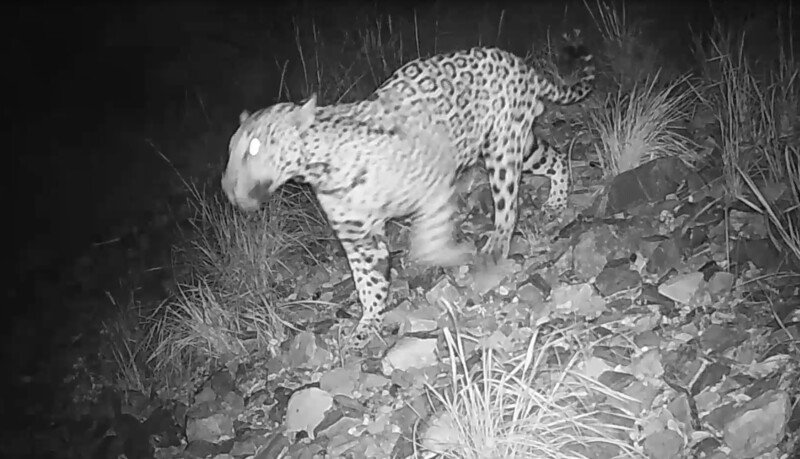
TUCSON, Ariz.— The Center for Biological Diversity released new footage today of a jaguar roaming the wilds of southern Arizona near a transnational wildlife movement corridor that is rapidly being closed by border wall construction.
The footage shows a large adult male jaguar, nicknamed “Cinco,” north of the San Rafael Valley in June and late July, after he was previously documented in March and April. He has roamed Arizona’s Sky Island mountain ranges near the valley since moving into the region from Mexico. The jaguar was first documented in the U.S. by researchers at the University of Arizona in late 2025.
“Each new video of Cinco is a glaring reminder that jaguars need to move freely between U.S. and Mexico and that Trump’s border wall is a deadly threat to their continued existence in Arizona,” said Russ McSpadden, Southwest conservation advocate at the Center for Biological Diversity. “This cat is showing us exactly where jaguars roam naturally and which corridors need to be protected, not walled off.”
The detections come as construction of two parallel 30-foot-tall border walls continues in the San Rafael Valley.
Two weeks ago protesters began a tree sit in an ancient cottonwood tree to stop the Trump administration from cutting it down after federal border wall contractors destroyed three neighboring cottonwoods estimated to be up to 250 years old. The tree sit, the first such action to block border wall construction, is ongoing.
The San Rafael Valley is a crucial movement corridor for jaguars, ocelots, black bears, pronghorn and hundreds of bird species.
Jaguars are protected as endangered in the U.S. and Mexico. Recovery of a breeding population in the U.S. will require carefully planned reintroduction and cross-border conservation, including cooperation among governments, Tribes, communities, land users and public interest groups.
Background
Jaguars are the world’s third-largest cats, after tigers and lions. They once lived throughout the American Southwest, from the South Rim of the Grand Canyon to the mountains of Southern California and as far east as Louisiana.
Over the past 150 years, jaguars largely disappeared from the U.S. portion of their range primarily because of U.S. government-sponsored predator eradication programs, hunting and habitat loss.
In 2014 the Center for Biological Diversity secured federal protection for hundreds of thousands of acres designated as critical habitat for jaguar recovery in the U.S.
The following year, Conservation CATalyst and the Center released the first video footage of a wild jaguar in Arizona, a male cat known as El Jefe.
In 2017 the Center released video footage of another wild jaguar in Arizona’s Chiricahua Mountains, a male cat known as Sombra.
In 2022 the Center petitioned the U.S. Fish and Wildlife Service to reintroduce jaguars in Arizona and New Mexico.
In 2025 the Wild Cat Research and Conservation Center documented Cinco, the fifth jaguar identified through the group’s monitoring efforts in the region. At least nine jaguars have been documented in the Southwest since 1996.
In a 2025 resolution, the San Xavier District of the Tohono O’odham Nation recognized the jaguar, or O:ṣhad, as a sacred animal and called for stronger habitat protections, restoration of wildlife corridors and the reintroduction of jaguars across parts of their historic range in the American Southwest.
In May 2026 the Trump administration issued a contract for a second border wall across the San Rafael Valley. Construction of a primary border wall started in September 2025 and already stretches across a large portion of the valley.