
For Immediate Release, May 12, 2026
|
Contact: |
Russ McSpadden, (928) 310-6713, [email protected] |
New Video Captures Rare Jaguar Roaming Southern Arizona Sky Islands
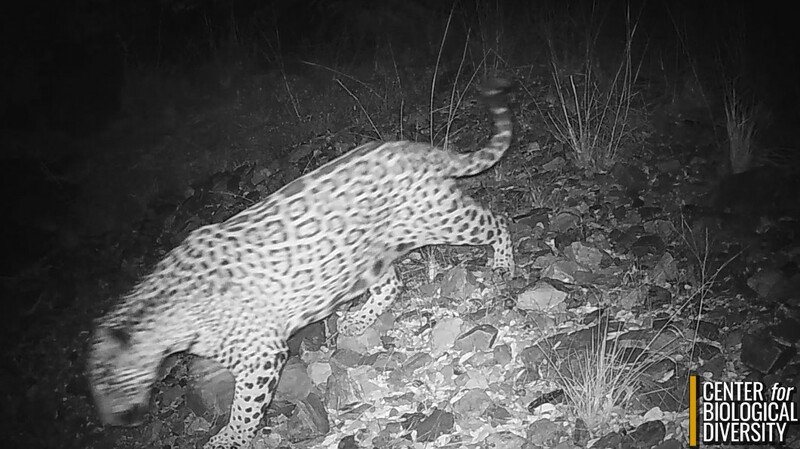
TUCSON, Ariz.— A new video released today by the Center for Biological Diversity captures a rare wild jaguar moving through a Sky Island mountain range south of Tucson, offering a striking glimpse of one of North America’s most endangered mammals.
“Seeing this incredible jaguar roaming in Arizona’s wild sky islands is a powerful reminder that these cats belong in the American Southwest and northern Mexico,” said Russ McSpadden, Southwest conservation advocate at the Center. “Tragically jaguars’ northern range is being ripped apart by Trump’s border wall construction, along with mining, groundwater depletion and climate-driven drought. We need to take urgent action to protect our vital cross-border ecosystems so jaguars can continue prowling the southern Arizona landscape alongside bears, pumas and ringtails. A landscape this wild is too precious to sacrifice.”
The footage, captured by remote wildlife cameras, includes three clips recorded in March and April 2026. The videos show a large adult male jaguar nicknamed “Cinco” by the Wild Cat Research and Conservation Center in 2025 after it became the fifth jaguar documented through the group’s monitoring efforts in the region. At least nine jaguars have been seen in the Southwest since 1996.
Jaguars are endangered in both the U.S. and Mexico, and their future depends on cross-border conservation efforts among governments, Tribal Nations, local communities and conservation groups to protect habitat, restore wildlife corridors and safeguard the interconnected ecosystems and Indigenous lands these cats have relied on for generations.
“I have prayed for the return of jaguars to these mountains, part of the ancestral lands of the O’odham” said Austin Nunez, chairman of the San Xavier District of the Tohono O’odham Nation. “Jaguars are protectors of the people and are a part of our spiritual life and our connection to this land. Seeing a jaguar still moving through these mountains gives me hope for future generations and reminds us of our responsibility to protect these majestic animals and the places they depend on.”
Background
Jaguars are the world’s third-largest cats, after tigers and lions. They once lived throughout the American Southwest, with historical records from the South Rim of the Grand Canyon, the mountains of Southern California and as far east as Louisiana. Over the past 150 years, jaguars largely disappeared from the U.S. portion of their range primarily because of hunting, habitat loss and U.S. government-sponsored predator eradication programs.
In 2014 the Center for Biological Diversity secured federal protection for hundreds of thousands of acres designated as critical habitat for jaguar recovery in the U.S.
The following year, Conservation CATalyst and the Center released the first video footage of a wild jaguar in Arizona, a male cat known as El Jefe.
In 2017 the Center released video footage of another wild jaguar in Arizona’s Chiricahua Mountains, a male cat known as Sombra.
In a 2025 resolution, the San Xavier District of the Tohono O’odham Nation recognized the jaguar, or O:ṣhad, as a sacred animal and called for stronger habitat protections, restoration of wildlife corridors and the reintroduction of jaguars across parts of their historic range in the American Southwest.
The Center for Biological Diversity is a national, nonprofit conservation organization with more than 1.8 million members and online activists dedicated to the protection of endangered species and wild places.
