
For Immediate Release, August 17, 2026
|
Contact: |
Laiken Jordahl, (928) 525-4433, [email protected] |
Emergency Injunction Sought to Block Big Bend Border Construction Despite Government Pause
TERLINGUA, Texas— The Center for Biological Diversity, Friends of the Ruidosa Church and a Big Bend-area river guide and landowner asked a federal judge today to halt border barrier and road construction across the Big Bend region while the court rules on a lawsuit challenging the federal government’s sweeping waiver of environmental and other laws to fast-track construction.
Customs and Border Protection today announced a pause in construction activities, responding to widespread nonpartisan outrage. But without action from Congress or the court, work could resume at any moment.
“We’ve been watching the permanent destruction of a great American national park unfold in real time,” said Laiken Jordahl, national public lands advocate at the Center for Biological Diversity. “Even with Customs and Border Protection pumping the brakes, the contractors could resume bulldozing deeper into the national park, causing irreversible damage to the wildest place in Texas. We’re hopeful the judge will stop this destruction until there’s a ruling on the merits of our case.”
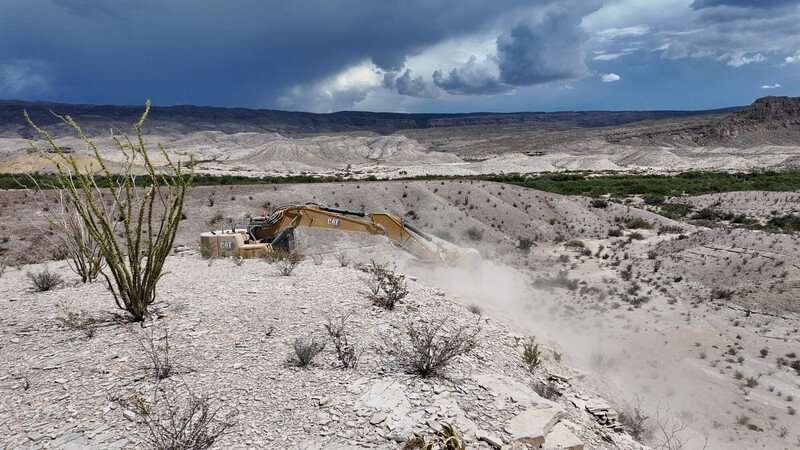
Bulldozers started tearing into Big Bend National Park near the iconic Santa Elena Canyon on Aug. 6 and were documented over the weekend plowing new routes for vehicle barriers into both the east and west sides of Mariscal Mountain. Contractors have stockpiled heavy equipment across the Big Bend region, where staging yards have been cleared, worker camps built and water wells drilled.
According to Customs and Border Protection’s online map, the agency plans to build vehicle barriers and patrol roads across Big Bend National Park, including in rugged and remote areas such as Mariscal Mountain that would require extensive dynamite blasting. The plans also include building in remote walled canyons where no unauthorized vehicle crossings have been documented and where vehicles cannot access the border with Mexico.
The underlying lawsuit challenges the federal government’s waiver of dozens of laws to fast-track border barrier construction through Big Bend National Park, Big Bend Ranch State Park and across the Big Bend region. The waiver marked the first time in U.S. history that the federal government has cast aside a broad slate of environmental laws — including the National Park Service Organic Act, Endangered Species Act and National Wild and Scenic Rivers Act — inside a national park.
Earlier this month, more than 140 outfitters, local businesses and recreation groups urged Texas leaders to protect public access to the Rio Grande and halt the project. They warned that closing river access and building permanent barriers and roads through the canyon corridor would put river outfitters out of business and devastate the regional economy.
The Big Bend Sector covers 517 miles, or more than a quarter, of the U.S.-Mexico border. No unauthorized vehicle crossings have been documented in the region, which saw just 1.3% of total border apprehensions in 2025. Within Big Bend National Park, apprehensions accounted 0.045% of the national total. For decades the National Park Service and Customs and Border Protection have conducted border enforcement while preserving the park’s irreplaceable natural heritage and recreational opportunities.
The plaintiffs are represented by attorneys at the Center for Biological Diversity and Texas Civil Rights Project.
The Center for Biological Diversity is a national, nonprofit conservation organization with more than 1.8 million members and online activists dedicated to the protection of endangered species and wild places.
