Carbon Capture and Storage
A Failed Technology Putting People at Risk
Carbon capture and storage, or CCS for short, is known by many other names that make it sound like a great idea — among them “CO2 removal,” “carbon sequestration,” “CO2 dumping,” and “CCUS” (which stands for “carbon capture, utilization, and storage”). Along with all those euphemisms, there’s a lot of misinformation and hype surrounding CCS — driven, of course, by those who benefit from it: the fossil fuel industry and other polluters, like the biomass industry.
No matter what its champions call it, the most important thing to know about CCS is that it’s not an effective climate solution. CCS is a dangerous delay tactic that takes vital resources away from the needed transition to clean, cheaper renewable energy like wind and solar, maintaining the status quo by entrenching fossil fuels and other dirty energy. Some have compared industries’ promotion of CCS to Big Tobacco’s touting cigarette filters as a way to make smoking “healthy.”
Despite proponents calling it “negative-emission technology,” the reality is that CCS only captures a portion of emissions from the smokestacks of industrial facilities, letting them continue releasing CO2 pollution. And CCS does nothing to remove the CO2 that's already in the atmosphere. After decades of development and billions in public subsidies, it's clear that CCS isn't effectively reducing emissions, and every project so far has failed to deliver on its promised carbon capture rates.
CCS is an energy-intensive process that diverts some carbon dioxide, or CO2, released from smokestacks. The CO2 is then compressed and transported under high pressure through pipelines, followed by injection and storage underground.
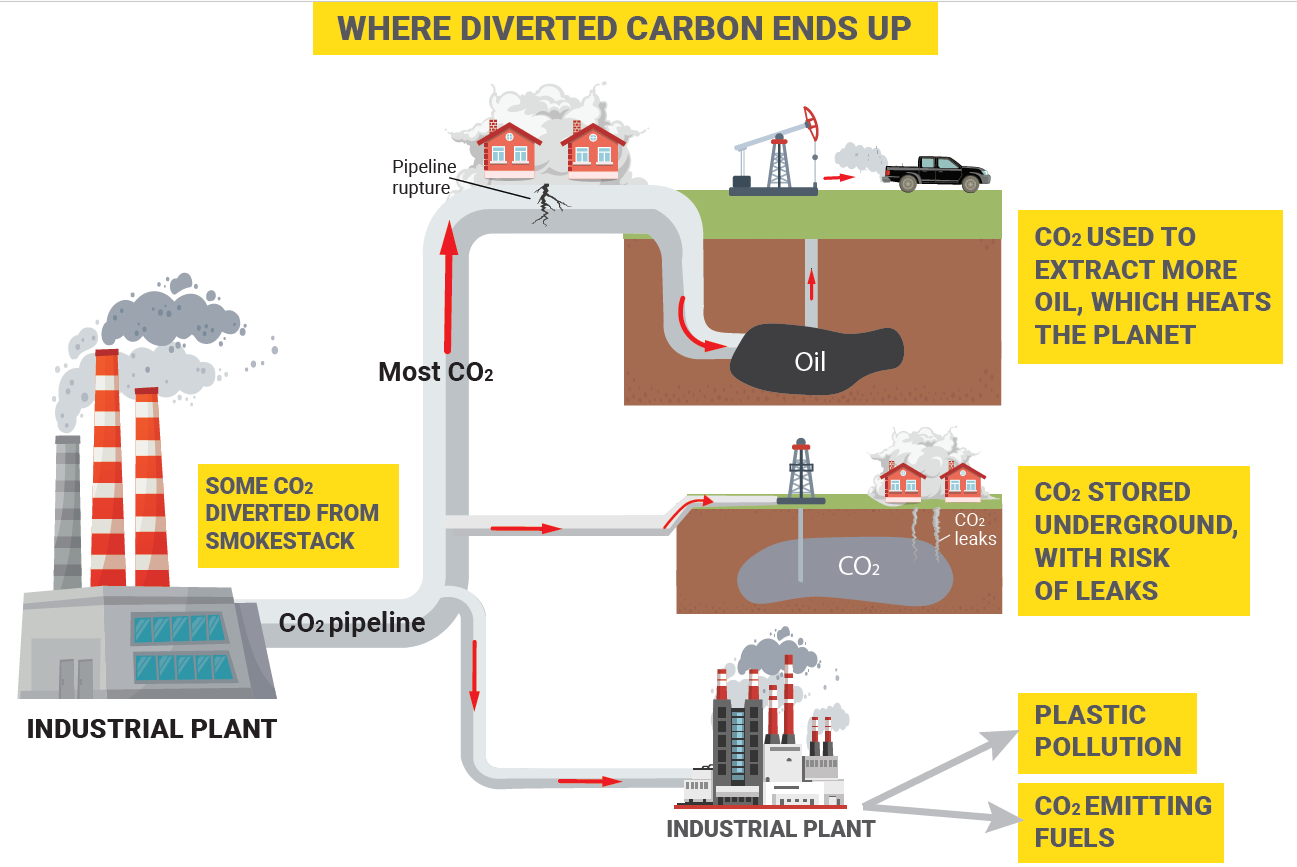
CCS projects can involve significant risk. The industry has a long history of leaks and explosions from storage wells, pipelines, and other facilities.
Meanwhile underground CO2 plumes can stretch for miles beneath homes, schools, and oil and gas fields, endangering communities and workers.
CCS faces widespread opposition from frontline communities, scientists, and environmental justice and climate groups. Vocal opponents include more than 500 organizations and the 1,800-group Climate Action Network-International, which spans more than 130 countries.
The Problems
CCS Is Ineffective at Meeting Climate Goals
CCS projects have systematically overpromised and underdelivered on carbon capture — unlike renewable solar and wind, which have fulfilled emissions-reduction promises while costs for these renewable energy sources continue to plummet.

The only U.S. fossil-fueled power plant to operate with CCS equipment — NRG Energy’s Petra Nova CCS project in Texas — vastly underperformed and was shut down indefinitely in 2020. Although Petra Nova promised a 90% carbon capture rate on this coal plant, a Stanford study found that its CCS equipment captured the equivalent of only 10-11% of the facility’s emissions after factoring in the emissions from the gas turbine used to run the CCS equipment, as well as all the emissions released by extracting the coal and getting it to the plant in the first place. The study concluded that CCS “reduces only a small fraction of carbon emissions, and it usually increases air pollution.”
As of late 2025 Chevron’s Gorgon plant in Australia — described as the “world’s biggest CCS project” — hadn’t met its five-year CO2-capture target of 80%. Instead it reported its lowest CO2 capture rate since being brought online in 2019 — only 25% — despite billions of dollars of investment and tens of millions in subsidies.
CCS Puts People at Risk
CCS poses an especially big threat to frontline communities. Besides entrenching the fossil fuel and biomass/biofuels industries — which already disproportionately harm those communities’ health and safety — it also creates new pollution and safety hazards. Communities of color and rural communities are particularly targeted for CCS development, especially along the U.S. Gulf Coast and in Louisiana’s petrochemical corridor known as “Cancer Alley,” as well as in areas of rural New Mexico, in the northern plains, and in California’s Central Valley.
Transporting, injecting, and storing CO2 involves a massive network of perilous pipelines connected to underground injection sites, which have been known to leak and rupture. Compressed CO2 is highly hazardous upon release, forming a cold, dense cloud that sinks to the ground, can spread for miles, and can sicken and asphyxiate (suffocate) humans and animals.
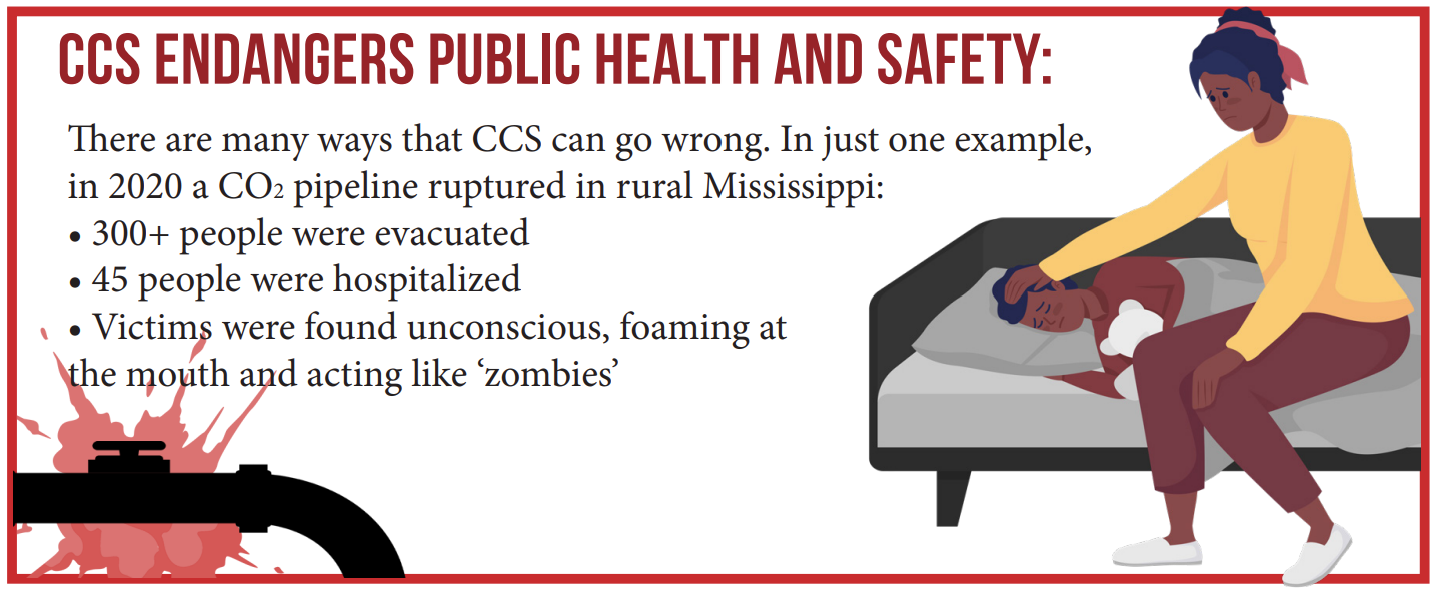
In February 2020 in rural Satartia, Mississippi, 300 people were evacuated and 45 people hospitalized when a CO2 pipeline ruptured. Since CO2 is odorless and colorless, community members were unaware of the harmful leak until it was too late. Thick clouds of CO2 prevented vehicles from operating, making it hard for people to evacuate and blocking emergency vehicles. While the federal pipeline agency recognized the urgent need to update CO2 pipeline safety regulations after this disaster, it still hasn’t updated them.
Underground CO2 storage poses further risks of leakage. Underground leaks can contaminate drinking water, trigger earthquakes, and cause CO2 to come back to the surface, where people and wildlife can breathe it and possibly suffocate.
CCS often uses toxic chemicals like lye and ammonia to “capture” carbon. To operate CCS at scale, millions of tons of these dangerous chemicals must be produced, transported, handled, and eventually dumped. That creates massive hazardous-chemical risks for workers and nearby communities.
CCS Technology Is Parasitic
That is, it requires more power and more resources, often yielding more emissions.
Unchecked, CCS will effectively lock in fossil fuel development for decades to come, in part by requiring brand-new fossil-fuel-fired power plants to support CO2-capture equipment.
Capturing CO2 requires vast amounts of energy and water. Some estimates put the “energy penalty” of CCS at 25%, meaning whatever “benefit” CCS has, that benefit is reduced by one quarter because of the energy demand. Some projects even propose building new fossil fuel-burning power plants just to power CO2 capture. Meanwhile, one estimate says, widespread global deployment of CCS to meet climate goals could almost double mankind’s water footprint.
Taxpayers Subsidize CCS Projects
Generally CCS projects rely heavily on public subsidies like tax breaks and credits, effectively making CO2 pollution a commodity. U.S. taxpayers could shell out billions of dollars per project. Plus, projects that allow for CCS on federal lands amount to another type of subsidy. Industry has even pursued CO2 pipelines and waste dumping in national forests — which, if allowed, would mean further societal costs in the form of industry giveaways and environmental degradation.
Even worse, fossil fuel companies get tax credits for using captured CO2 emissions to extract more oil and gas. Globally 80% of the CO2 captured at CCS facilities is currently used to extract oil through “enhanced oil recovery” — a technique using extreme methods to squeeze out more of a reservoir's oil after the usual methods are exhausted — worsening the climate crisis. That oil is then burned, producing more CO2 and toxic pollutants in a vicious cycle.
Public subsidies give the fossil fuel industry a financial lifeline — while dooming everyone else to climate disaster.
BECCS: A Similar Problem With a Different Disguise
In one type of CCS, called bioenergy with carbon capture and storage, or BECCS for short, CCS equipment is added to bioenergy facilities. These facilities incinerate trees and crop “biomass” — which would’ve provided natural carbon storage if left alive — to make electricity or fuels, releasing CO2 and toxic air pollutants. BECCS comes with all the climate, health, and safety dangers of CCS but with the added harm of being even more water intensive. It also adds threats to biodiversity, food security, and human rights from the heavy land use, forest cutting, and ecosystem destruction needed to feed its facilities.
Our Campaign
The Center’s CCS campaign is bringing our legal, scientific, and organizing expertise to work at the federal level and in various states, including California and New Mexico, to oppose the poorly vetted buildout of CCS projects and CO2 pipelines. We work with national and local partners to educate policymakers and decisionmakers about the harms of CCS, to oppose specific problematic project permits, to track CCS projects and proposed federal actions using public-records requests, to bring attention to troubling regulatory gaps and loopholes, and to amplify efforts to uplift community concerns.
CCS isn’t an effective or just pathway to meeting global emissions-reduction goals. We must invest in an equitable transition to clean, renewable solar and wind energy that furthers environmental justice and ends fossil fuels, leaving no worker or community behind. It’s past time to focus on proven solutions to the climate crisis and reverse the deadly damage wrought by the fossil fuel industry.