
For Immediate Release, January 23, 2026
|
Contact: |
Deeda Seed, (801) 803-9892, [email protected] |
Wilson’s Phalarope Advances Toward Endangered Species Protection
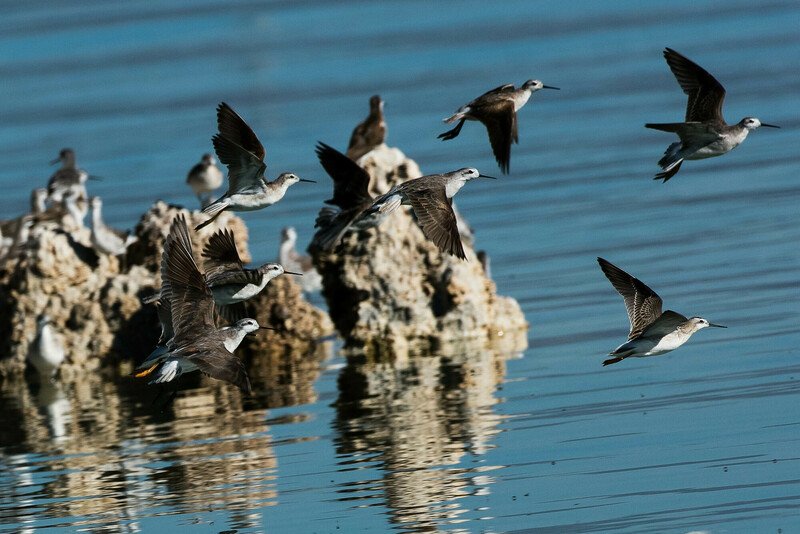
SALT LAKE CITY— The U.S. Fish and Wildlife Service announced today that Wilson’s phalaropes — migratory shorebirds that rely on saline lakes in the American West — will advance to the next stage of review to determine whether they warrant protection under the Endangered Species Act.
In its positive 90-day finding, the Service said a 2024 petition submitted by conservationists, scientists, public health advocates and community members presented substantial scientific evidence that listing the bird may be warranted.
The petition cited extensive hydrologic and climate evidence showing that the decline of Great Salt Lake — an essential migratory stopover — poses a risk of extinction for the bird.
“Wilson’s phalarope is sounding the alarm bell about the Great Salt Lake’s decline,” said Deeda Seed, senior Utah campaigner at the Center for Biological Diversity. “I’m thrilled these little birds are one step closer to the protection they so desperately need, and I’m hopeful this leads to real action to save the Great Salt Lake.”
The 120-page petition was primarily authored by Ryan Carle, science director of Oikonos Ecosystem Knowledge, and co-signed by author Terry Tempest Williams, Utah Physicians for a Health Environment, Utah Youth Environment Solutions, the Mono Lake Committee, the Center for Biological Diversity, retired U.S. Fish and Wildlife Service biologist Ron Larson, and scientists Ben Abbott, Nathan D. Van Schmidt, and Kyriana Tarr.
“The Wilson’s phalarope is Great Salt Lake’s canary in the coal mine. As the lake shrinks, this tiny bird is a warning that what’s happening to the lake is happening to all of us,” said author and Center board member Terry Tempest Williams. “The U.S. Fish and Wildlife Service taking our petition seriously should be a wake-up call to families along the Wasatch Front, state legislators, and faith and business leaders. We all need to act with urgency to get water back into the lake now. This isn’t about politics. It’s about the survival of the lake, its wildlife and our communities. The winds are shifting, and whether they bring toxicity or restoration is up to us."
Most Wilson’s phalaropes stop at the Great Salt Lake during their migration between North to South America, where they molt and gain weight by feeding on the abundant brine shrimp in the saline lake. Other important stopover points include Mono Lake in California and Lake Abert in Oregon.
The Great Salt Lake’s level dropped sharply because of overuse of water by the agriculture, municipal and mining sectors. If the lake falls below critical levels, salinity will become too high for brine shrimp, leaving Wilson’s phalarope with nothing to eat to gain enough weight for their long globe-trotting migratory journey.
“We are happy to hear about this positive outcome and hope it leads to protection of the Wilson’s Phalarope, which needs a healthy Great Salt Lake ecosystem to survive. If we allow these birds and their habitat to disappear, we will also be endangering life along the Wasatch Front for humans as well,” said Jonny Vasic, Executive Director at Utah Physicians for a Healthy Environment. “As a physician’s group, we feel a moral obligation to do whatever we can to mitigate the decline of Great Salt Lake and the disturbing trend of species and habitat loss.”
Lawmakers in Utah have spent several years pursuing measures to save the Great Salt Lake, but the amount of water that has actually reached the lake is questionable. Lake levels are hovering just above the catastrophic lows of 2022 that prompted the Wilson’s phalarope petition. Record warmth and lack of snow are setting the Great Salt Lake up for another potential record low this year.
In today’s 90-day finding, the Service found that, “freshwater diversion leading to declines in prey resources at primary fall staging habitats in California, Oregon, and Utah” — which may be “ameliorated or exacerbated” by “existing regulatory mechanisms” — led to the conclusion that the listing may be warranted.
"By saving the phalaropes, we can save the Great Salt Lake and protect future generations,” said Adalayde Scott, a 17-year-old leader with Utah Youth for Environmental Solutions. “As a young person, my fate is intricately intertwined with that of the phalarope and all species whose homes are under threat, the way mine is too. When you choose to save something smaller than yourself, you are showing me that you want to save me and my future too."
The Center for Biological Diversity is a national, nonprofit conservation organization with more than 1.8 million members and online activists dedicated to the protection of endangered species and wild places.
