
For Immediate Release, July 1, 2026
|
Contact: |
Cooper Freeman, (907) 531-0703, [email protected] |
Whale-Hitting Cruise Ship Was Likely Traveling Above Safe Speeds, Analysis Finds
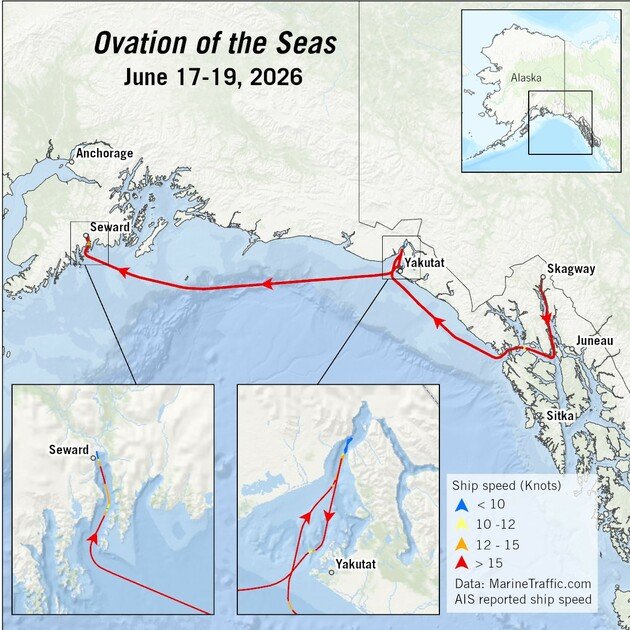
ANCHORAGE, Alaska— The Royal Caribbean mega-cruise ship that hit a pregnant fin whale in the Gulf of Alaska was likely traveling at speeds that would greatly increase the risk of a deadly whale strike, a new Center for Biological Diversity analysis shows. The ship carried the dead endangered whale on its bow into port in Seward, Alaska, on June 19.
“It’s disturbing to discover that this massive cruise ship was likely zooming around in coastal waters where we know whales congregate, and we need to know more about the role that speed might have played in this tragedy,” said Cooper Freeman, Alaska director at the Center for Biological Diversity. “I’m sure passengers would have wanted the ship to slow down rather than hit one of the majestic and endangered whales they came to Alaska to see. Cruise ship companies can choose to implement whale-safe speed limits today and do their part to protect Alaska’s incredible marine life.”
The cruise ship was likely traveling between 15 and 20 knots in coastal waters and bays where whales are known to congregate, according to the Center’s analysis of the ship’s AIS (Automatic Identification System) data from MarineTraffic.com. Utilizing terrestrial and satellite AIS data points, the Center mapped the ship’s voyage from Skagway to Seward. This data reflects the ship’s Speed Over Ground (SOG) calculated by its internal GPS and broadcast via its AIS transponder. While AIS data enables highly accurate estimates of a ship’s speed, various factors can cause data errors or gaps.
Every 1-knot rise in vessel speed results in a 1.5 times increase in the likelihood that a vessel strike kills or seriously injures a large whale, according to one study. That same study determined that the probability of a fatal strike event is 20% at 9 knots, 50% at 11.8 knots, 80% at 15.3 knots, and nearly 100% if a vessel is traveling above 15.3 knots.
The Center sent a letter to Royal Caribbean on June 24 urging the company to adopt a policy of requiring their cruise ships to slow to 10 knots or less when traversing through sensitive whale habitat areas. The company has not responded.
An official cause of death has not been declared, but a necropsy by federal scientists showed “blunt force trauma to the jaw, spine, and ribs consistent with a vessel strike.” The examination found that the whale was freshly dead and healthy, with “plenty of blubber and muscle.” Ship strikes are a leading cause of large whale mortality around the world.
“I was stunned when I saw how fast this monster cruise ship could have been traveling,” said Freeman. “I hope the federal investigation sheds more light on the Alaska incident, but we already know how critical speed limits are to reducing the chance of a ship striking a whale. Our federal government should require that cruise ships travel at these safer speeds in whale hotspots, but there’s nothing stopping cruise lines from slowing down on their own initiative. This tragic death should be a wake-up call for the cruise industry, and I call on these companies to face facts and take action.”
The Royal Caribbean’s Ovation of the Seas is the largest cruise ship to dock in Seward. A new terminal — now the largest in Alaska — was recently built to accommodate it and other mega cruise ships. The terminal officially opened June 10. June 19 was the ship’s second-ever port call in Seward. The new terminal is expected to facilitate a significant increase in the size and frequency of cruise ships in Seward, raising the risk of additional whale strikes, especially without speed limits for these vessels in place.
The Center for Biological Diversity is a national, nonprofit conservation organization with more than 1.8 million members and online activists dedicated to the protection of endangered species and wild places.
