
For Immediate Release, January 29, 2026
|
Contact: |
Noah Greenwald, Center for Biological Diversity, (503) 484-7495, [email protected] |
Study: Montana’s Arctic Grayling Fail to Recover Under Voluntary Conservation Agreement
BUTTE, Mont.— The Center for Biological Diversity released an analysis today showing that a two-decade, state-led voluntary conservation agreement has not produced a measurable increase in the abundance of critically imperiled Arctic grayling in Montana’s Big Hole River. The waterway is home to the last true river-dwelling population of these imperiled fish.
Today’s analysis also found no measurable improvement in summer and early fall water flows, when the river is typically at its lowest.
“The state’s conservation agreement is well intentioned but it has failed to address low water levels, which are the greatest threat to the survival of these beautiful fish,” said Noah Greenwald, endangered species co-director at the Center. “Chronic summer low flows are bad for fish and people alike. The only solution to this problem is to leave more water in the river.”
The report was led by fisheries biologist Gary Rule, with co-authors Richard Domingue and Blane Bellerud, retired National Marine Fisheries Service scientists with decades of experience reviewing the status of fish and their freshwater habitats.
Their analysis found that numbers of adult grayling have remained largely flat despite episodic pulses in reproduction. The report further found that river flow targets established in the conservation agreement are likely insufficient and have not been met in most years. This has led to warmer stream temperatures, which are harmful to Arctic grayling.
“The weight of evidence from decades of monitoring shows that Big Hole grayling habitat conditions — and overall viability — have not improved: Low late-summer flows and elevated temperatures still squeeze rearing habitat, and adult abundance remains essentially flat since the historic lows documented in 2002,” said Gary Rule, lead author of the report and a former government scientist.
Once found throughout the upper Missouri River Watershed above Great Falls, Montana’s Arctic grayling have been lost from most of the rivers and creeks where they once lived.
The last true river-dwelling population survives in the Big Hole River, where heavy irrigation withdrawals and climate change threaten its survival. Every summer, river flows drop and stream temperatures warm, harming grayling and contributing to perilously low population numbers.
The U.S. Fish and Wildlife Service first identified the need to protect the grayling under the Endangered Species Act in 1982. Despite that, the fish waited in limbo until 2014, when the Service reversed course and decided not to protect them. The Center and Western Watersheds Project, represented by Earthjustice, successfully challenged this denial, but in 2020 the Service doubled down and again denied protections. The groups again successfully sued and a new decision is now due in February 2027.
This is the second report by independent scientists on the status of grayling. An earlier report by Zachary Hoylman, chief scientist with Hydrosphere Analytical, similarly found that Big Hole River flows are continuing to decline using different statistical methods.
Background
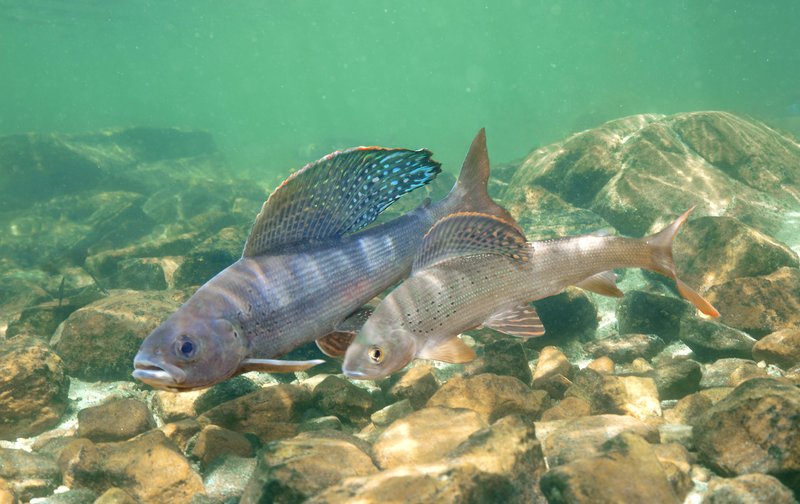
A member of the salmon family, Arctic grayling are beautiful fish with prominent and colorful dorsal fins. They thrive in cold freshwater streams and rivers across Canada and Alaska.
Historically, river-dwelling populations of Arctic grayling existed in only two places in the lower 48 states: Michigan and the upper Missouri River of Montana. Populations in Michigan went extinct by the 1930s, and populations in Montana had become restricted to the Big Hole River and a few lakes by the end of the 1970s. Studies demonstrate that Montana’s grayling are genetically distinct from populations in Canada and Alaska.
Grayling have been reintroduced in the Ruby River, where fish have reproduced, but the population remains very small. Grayling also survive in the Ennis Reservoir on the Madison River and the Centennial Lakes. All of these populations face threats from a variety of sources, including irrigation withdrawals that reduce flows and raise stream temperatures, climate change and habitat degradation due to livestock grazing, roads and agriculture. Grayling have also been introduced into high elevation lakes outside their native range.
The Center for Biological Diversity is a national, nonprofit conservation organization with more than 1.8 million members and online activists dedicated to the protection of endangered species and wild places.
