
For Immediate Release, September 24, 2026
|
Contact: |
Russ McSpadden, (928) 310-6713, [email protected] |
Sacred Arizona Archaeological Site Damaged by Trump’s Wall Predates Stonehenge
Geoglyph in National Wildlife Refuge is Oldest in Americas
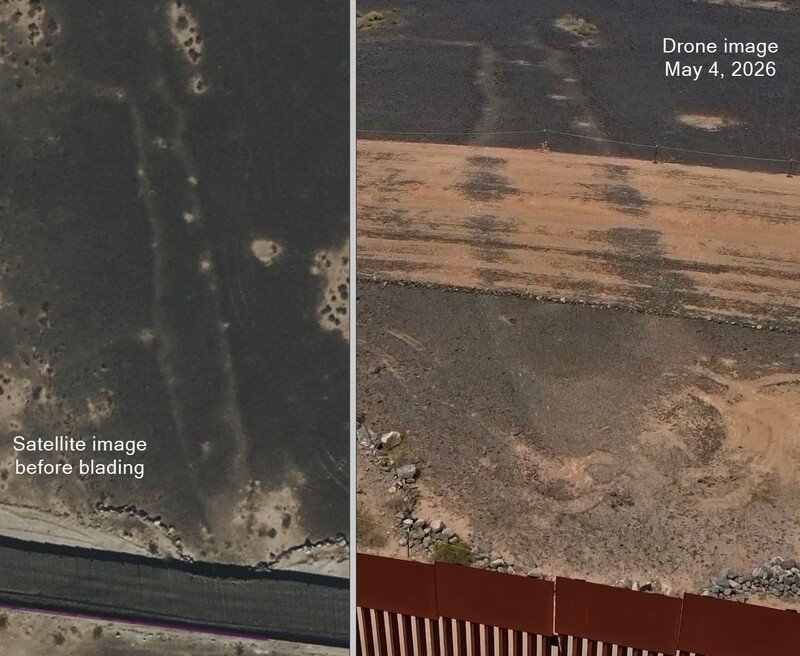
AJO, Ariz.— New research dates the Las Playas Intaglio, previously believed to be about 1,000 years old, to at least 6,500 years ago. The sacred Indigenous geoglyph was partially destroyed in April by federal contractors working on the Trump administration’s second border wall through Arizona’s Cabeza Prieta National Wildlife Refuge.
“This discovery makes an already devastating loss even more profound. It’s a cultural and historical atrocity,” said Russ McSpadden, Southwest conservation advocate at the Center for Biological Diversity. “The Trump administration’s destruction of this 6,500-year-old site is a wound to the deep history of Indigenous communities and impoverishes all of humanity. No administration has the moral authority to bulldoze an irreplaceable piece of the human story.”
Its estimated age places its creation roughly 2,000 years before Egypt’s first pyramid, 4,000 years before Peru’s Nazca Lines and 1,500 years before the first construction of Stonehenge.
The findings, published in the September issue of The SAA Archaeological Record, identify the fish-shaped earthwork as the oldest scientifically dated geoglyph in the Americas, according to authors David S. Whitley and Ronald I. Dorn.
The researchers used varnish microlamination dating, a technique developed over decades that matches microscopic layers of rock varnish to a regional record of ancient climatic conditions. They examined stones collected from the intaglio in 1979. Three samples supported a conservative age estimate of 6,500 to 7,300 years. Because the varnish formed after the earthwork was created, the geoglyph could be even older.
On April 23 contractors for U.S. Customs and Border Protection drove heavy equipment through the intaglio while preparing land for construction of a second border barrier. The Center documented a roughly 50-foot-wide scraped corridor cutting through part of the 272-foot-long figure and the surrounding refuge.
Las Playas lies within the ancestral homeland of the Tohono O’odham, Hia-Ced O’odham and other Tribes. Intaglios were created by clearing dark stones from desert surfaces to expose lighter ground beneath. The researchers describe these places as central to Indigenous cultural and religious traditions, Tribal identity and continuing relationships with ancestral lands.
“Imagine the worldwide outrage if a government bulldozed part of Stonehenge to build a wall,” said McSpadden. “This sacred place is even older. Indigenous heritage deserves that same commitment to protection. Congress needs to demand records and testimony establishing who authorized and carried out the work. People deserve to know what warnings were given and why safeguards, if they existed, failed.”
The damage follows earlier destruction of sacred places, including the February 2020 blasting of Monument Hill, a burial ground sacred to the O’odham in Organ Pipe Cactus National Monument. Construction has also destroyed saguaros, which the Tohono O’odham Legislative Council recognized as O’odham persons and kin in a May 2021 resolution condemning their destruction.
In January 2025 the San Xavier District Council called for protecting the sacred jaguar and its habitat and movement corridors from border barriers and other threats. Construction for primary and secondary walls is now cutting across the San Rafael Valley, a crucial jaguar corridor between Mexico and the United States.
Construction on a second parallel wall also threatens Quitobaquito Springs, a sacred O’odham oasis in Organ Pipe Cactus National Monument where bulldozing and groundwater pumping could permanently damage the water system sustaining rare aquatic wildlife.
UNESCO’s 2003 declaration concerning the Intentional Destruction of Cultural Heritage recognizes that such destruction harms all humanity and calls for prevention and criminal sanctions consistent with international law. The United Nations Declaration on the Rights of Indigenous Peoples affirms Indigenous peoples’ rights to protect their heritage and cultural and religious traditions.
Customs and Border Protection is accepting public comments on 225 miles of secondary border wall construction across Arizona through Oct. 12. Submit comments by email to [email protected] with “Tucson Sector Secondary Barrier Construction” in the subject line.
The Center for Biological Diversity is a national, nonprofit conservation organization with more than 1.8 million members and online activists dedicated to the protection of endangered species and wild places.
