
For Immediate Release, March 17, 2026
|
Contact: |
Tierra Curry, Center for Biological Diversity, (928) 522-3681, [email protected] |
Migratory Eastern Monarch Butterflies Remain At Risk of Extinction
New Census Data Shows Population Up Slightly
WASHINGTON— The annual count of migratory monarchs who spend the winter in Mexico was released today and shows that the beloved orange-and-black butterflies remain vulnerable to extinction.
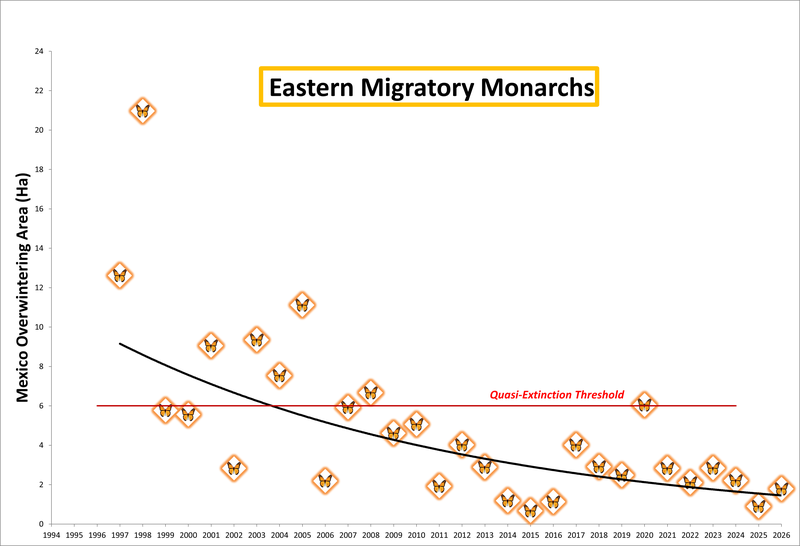
Though marking an improvement over last year, this year’s count of 7.24 acres of occupied habitat remains perilously low and is less than half the size needed for monarchs to be clear of the danger of migratory collapse.
“Monarchs need our help, and we need monarchs because they are spectacular and irreplaceable,” said Tierra Curry, endangered species co-director at the Center for Biological Diversity. “It would be unforgivable for their epic migrations to collapse because of political cowardice on enacting range-wide protections for them. Even the Trump administration has to think twice about letting these iconic butterflies collapse toward oblivion.”
Migratory monarchs have declined by more than 80% since the 1990s. The monarch was proposed for Endangered Species Act protection in December 2024, but instead of finalizing protections Trump officials delayed the decision as a “long-term action,” with no definitive date for listing. The Center for Biological Diversity and Center for Food Safety filed a lawsuit in February to secure a date for final protections.
“The monarchs’ crisis is a damning indictment of industrial agriculture’s toxic legacy,” said George Kimbrell, legal director at the Center for Food Safety. “For decades regulators have ignored the science while approving more pesticides that destroy habitat and poison pollinators. We must protect monarchs before it is too late.”
Monarch butterflies west of the Rocky Mountains overwinter mostly on the central coast of California. The western migratory population is down more than 95% since the 1980s and numbered less than 12,260 butterflies this winter, the third lowest count on record.
A federal assessment of the monarch’s status found that in the next 60 years eastern monarchs have up to a 74% chance of going extinct and western monarchs have up to a 99% chance of being lost.
Conservationists first sought federal safeguards for the butterflies in 2014 when the Center for Biological Diversity, Center for Food Safety, Xerces Society for Invertebrate Conservation and renowned monarch scientist Lincoln Brower filed a scientific and legal petition with the U.S. Fish and Wildlife Service seeking protection for the butterflies as threatened under the Endangered Species Act. The butterflies were placed on a candidate waiting list for protection in 2020. The centers filed a lawsuit to elevate them from bureaucratic limbo resulting in the proposed listing in 2024.
Background
In one of the longest migrations of any insect, at the end of summer eastern monarchs fly from the northern United States and southern Canada to overwinter together in high-elevation fir forests in Mexico. The population size is determined by measuring the area of trees turned vivid orange by the clusters of butterflies. Though this year’s count marks a 64% increase compared to last year’s size of 4.42 acres, scientists estimate that 15 acres of occupied forest is the minimum threshold for the migrating pollinators to be above extinction risk in North America.
The annual count of eastern butterflies is conducted by the World Wildlife Fund-Telmex Telcel Foundation Alliance and the National Commission of Protected Natural Areas in Mexico.
Monarchs face tremendous threats. Their initial decline was driven by widespread loss of milkweed, the caterpillar’s sole food source, due to increased use of the herbicide glyphosate on fields of corn and soybeans genetically engineered to resist it. Volatile herbicides sprayed on newer herbicide-resistant crops drift and reduce floral resources required by adult butterflies. All stages of monarchs are harmed by neonic insecticides used in crop seed coatings and on ornamental plants.
Climate change is damaging the forests where monarchs winter and extreme weather events are interfering with reproduction and migration. Grasslands and other green spaces that provide wildflowers for nectaring adults continue to be lost to development.
Millions of monarchs are killed by vehicles annually as they migrate across the continent. In their winter habitat in Mexico, forests and streams are being decimated to grow avocados for unsustainable U.S. demand. In California, more than 60 known overwintering forest sites have been cut down.
The Center for Biological Diversity is a national, nonprofit conservation organization with more than 1.8 million members and online activists dedicated to the protection of endangered species and wild places.
