
For Immediate Release, October 15, 2026
|
Contact: |
Alejandro Olivera, Center for Biological Diversity, +1 (202) 849-8403, [email protected] |
Mexico Eviscerates Vaquita Protections
World’s Most Endangered Marine Mammal at Greater Risk of Extinction
MEXICO CITY— Mexico has weakened protections for the critically endangered vaquita porpoise, opening vast new areas in the Upper Gulf of California to the deadly gillnet fishing that has caused the vaquita’s precipitous decline.
Scientists estimate that only about 10 vaquitas remain, down from nearly 600 animals in 1997. Mexico’s new rules, issued yesterday, eviscerate protections adopted in September 2020, which were not fully implemented and would have significantly improved the vaquita’s chance of recovery.
“With only a handful of vaquita left, it’s absolutely shocking that the government is gutting protections rather than stepping up to help these little porpoises,” said Alex Olivera, Mexico representative at the Center for Biological Diversity. “Instead of ramping up enforcement, Mexico is normalizing illegal fishing that the government has been unable or unwilling to stop. These new rules open most of the vaquita’s remaining habitat to the gear that kills them. Vaquitas don’t follow maps, and scientists have repeatedly seen the porpoises outside the only area where the gillnet ban is currently enforced. It’s heartbreaking because if this isn’t reversed it will almost certainly lead to the vaquita’s tragic extinction, which could’ve been prevented.”
Vaquitas face one primary threat: They become entangled and drown in gillnets used to catch shrimp and totoaba, a large, endangered fish whose swim bladder is trafficked primarily to Asia for enormous profits.
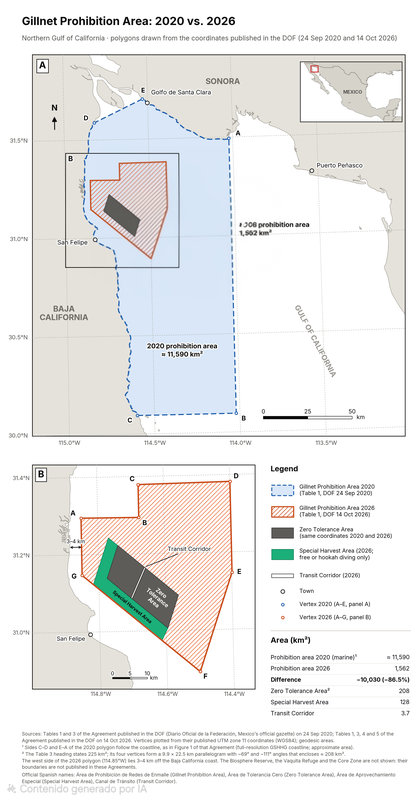
Mexico’s new regulations reduce the area where gillnets were prohibited by approximately 86%, removing the gillnet ban from thousands of square kilometers of the vaquita’s historical habitat. The new regulations also establish a vessel transit corridor approximately 350 meters wide through the “Zero Tolerance Area,” where both fishing and vessel traffic had been prohibited. These changes undermine enforcement efforts to prevent illegal gillnet fishing and totoaba trafficking.
“The use of gillnets in vaquita habitat is incompatible with the species’ survival, let alone recovery,” said Zak Smith, a senior attorney at NRDC. “Mexico’s poor management of gillnet fishing drove the vaquita to near extinction. Now, its choice to allow the use of gillnets in more of the vaquita’s habitat narrows the possibility of the species’ survival and may seal the vaquita’s sad fate.”
The new regulations also create opportunities for potentially harmful fishing activity in and around vaquita habitat. They allow authorized gillnet fishing outside the newly reduced gillnet prohibition area, establish a Special Use Area where fishing by free diving or hookah is permitted, and shorten the nighttime fishing prohibition by three hours.
Although the regulations call for the implementation of satellite vessel tracking, this requirement will not take effect for another 12 months. These changes will increase fishing pressure in areas important to the survival of the critically endangered vaquita.
“Mexico’s new regulations will expedite the extinction of the vaquita. The rules entirely contradict what should be done to save a critically endangered species,” said DJ Schubert, senior wildlife biologist with the Animal Welfare Institute. “Rather than strengthening enforcement and retaining an ample protected area for the species, the new regulations will protect vaquita in only a fraction of its historic range and allow deadly gillnets to be used in vaquita habitat potentially jeopardizing the future existence of the species. Mexico should reverse these rollbacks, strengthen on-the-water enforcement, and maintain protections that reflect the vaquita’s real, shifting distribution and facilitate population recovery.”
The Center for Biological Diversity is a national, nonprofit conservation organization with more than 1.8 million members and online activists dedicated to the protection of endangered species and wild places.
NRDC (Natural Resources Defense Council) is an international nonprofit environmental organization with more than 3 million members and online activists. Established in 1970, NRDC uses science, policy, law and people power to confront the climate crisis, protect public health and safeguard nature. NRDC has offices in New York City, Washington, D.C., Los Angeles, San Francisco, Chicago, Beijing and Delhi (an office of NRDC India Pvt. Ltd).
The Animal Welfare Institute (awionline.org) is a nonprofit charitable organization founded in 1951 and dedicated to alleviating animal suffering caused by people. We seek to improve the welfare of animals everywhere: in agriculture, in commerce, in our homes and communities, in research, and in the wild. Follow us on Facebook, Instagram, Threads, Bluesky, and LinkedIn for updates and other important animal protection news.
