
For Immediate Release, December 9, 2025
|
Contact: |
Krista Kemppinen, (602) 558-5931, [email protected] |
Lawsuit Launched to Protect Sky Island Plant Threatened by Mining
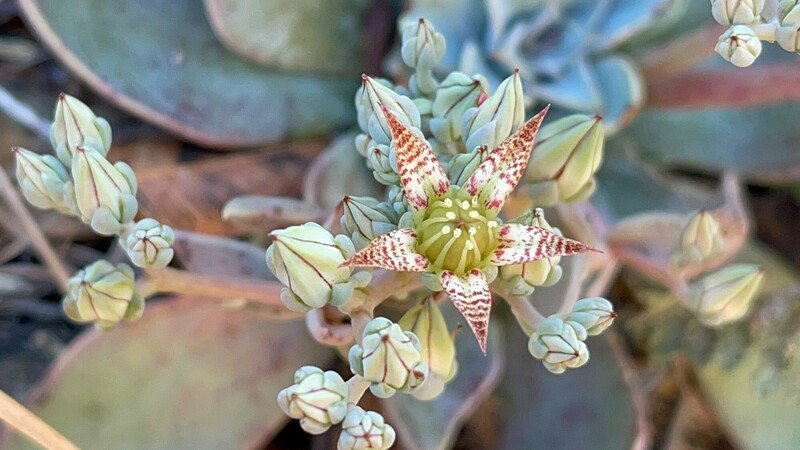
TUCSON, Ariz.— The Center for Biological Diversity today filed a 60-day notice of intent to sue the U.S. Fish and Wildlife Service for failing to provide habitat protection to Bartram’s stonecrop, a blue-green desert succulent found only in the Sky Islands of southern Arizona and northern Mexico.
“Mining in southern Arizona could wipe out these beautiful deep canyon succulents, and they urgently need protections for the places they live,” said Krista Kemppinen, Ph.D., a senior scientist at the Center. “I hope our notice pushes the Fish and Wildlife Service to move forward on protecting this plant’s critical habitat, as the law clearly requires. These rare plants are part of the complex web of life that makes the Sky Islands so special, and they need our help to survive.”
Bartram’s stonecrop was protected under the Endangered Species Act in 2021 but the Service determined that designating critical habitat was “not prudent,” claiming that the protection would increase the risk of illegal collection.
That decision overlooked the Service’s own finding that habitat loss tied to groundwater withdrawals for mining operations could wipe out all remaining U.S. populations of the plant. It also failed to account for the protections that critical habitat designation can provide against those and other threats.
Although illegal collection is an acknowledged general threat for succulents, there is limited evidence of such collection in relation to the stonecrop. In addition, a lawful critical habitat designation would not be limited to the plants’ precise locations but encompass surrounding areas, such as those needed by pollinators.
Bartram’s stonecrop grows only in shaded outcrops and crevices in canyons near streambeds, springs and seeps. These moist microhabitats are particularly vulnerable to groundwater extraction, drought and warming, which can result in dewatering and associated loss of the shade and humidity essential to the plant’s survival.
Fifty populations of the plant remain in 12 Sky Island mountain ranges. Nine of those mountains — the Baboquivari, Chiricahua, Dragoon, Mule, Pajarita-Atascosa, Patagonia, Rincon, Santa Rita and Whetstone — are in the U.S. There are mining claims or operations near each of these populations. The plant is also threatened by altered fire regimes, grazing and drought.
More than half of the 50 remaining populations contain fewer than 50 plants. The Service estimates that only 4,300 individual plants remain in the U.S. Nearly 90% of these populations are located on federal public land administered by the U.S. Forest Service and National Park Service.
The stonecrop was first identified as a candidate for federal listing in 1980. The Center petitioned for protection of the plant in 2010 and in 2020 sued the Trump administration for failing to decide whether 241 plants and animals across the country, including Bartram’s stonecrop, should be protected under the Endangered Species Act.
The Center for Biological Diversity is a national, nonprofit conservation organization with more than 1.8 million members and online activists dedicated to the protection of endangered species and wild places.
