
For Immediate Release, June 11, 2026
|
Contact: |
Laiken Jordahl, (928) 525-4433, [email protected] |
Lawsuit Expanded to Challenge Border Barrier Construction Through Big Bend National Park
TERLINGUA, Texas— The Center for Biological Diversity, Friends of the Ruidosa Church and a Big Bend-area landowner amended their lawsuit against the Department of Homeland Security today to challenge the unconstitutional waiver of dozens of laws to fast-track border barrier construction through Big Bend National Park.
“Until now no administration has been heartless enough to waive laws in a national park like Big Bend, so we’re suing to uphold the U.S. Constitution and protect this crown jewel,” said Laiken Jordahl, national public lands advocate at the Center for Biological Diversity. “Federal environmental laws were passed to keep our national parks wild forever. It’s unconstitutional to waive those laws to bulldoze border barriers and roads through Big Bend and I’m hopeful a court will agree. We’ll keep dragging the administration back to court until this horrific project is stopped for good.”
On Tuesday the Department of Homeland Security waived dozens of environmental laws to authorize construction of border barriers and roads through Big Bend National Park and Big Bend Ranch State Park. The move marked the first time in U.S. history that the federal government has cast aside a broad slate of environmental laws — including the National Park Service Organic Act, Endangered Species Act and National Wild and Scenic Rivers Act — inside a national park.
Today’s amended complaint, filed in U.S. District Court in the Western District of Texas, adds the national park waiver to a lawsuit first brought in April. The lawsuit says the department violated a provision in the U.S. Constitution that requires congressional approval for actions with vast economic and political consequences.
The national park waiver deepens those constitutional violations by stripping the National Park Service Organic Act, which mandates that parks be preserved unimpaired for future generations, without congressional authorization. Together, both waivers account for nearly a quarter of the U.S.-Mexico border.
Although Customs and Border Protection’s online map shows that steel vehicle barriers and patrol roads are planned for this stretch of border, this week’s waiver authorizes construction of the full suite of border barrier infrastructure, including “fencing, barriers, roads, lighting, cameras, and sensors.”
In May the Department of Homeland Security awarded a $1.7 billion contract for border work through the national park. The contract states it is “for border wall through Big Bend.” Last week the department awarded another $2.6 billion contract, the costliest border construction contract yet, for the Lower Canyons stretch of the Rio Grande, a designated national Wild and Scenic River.
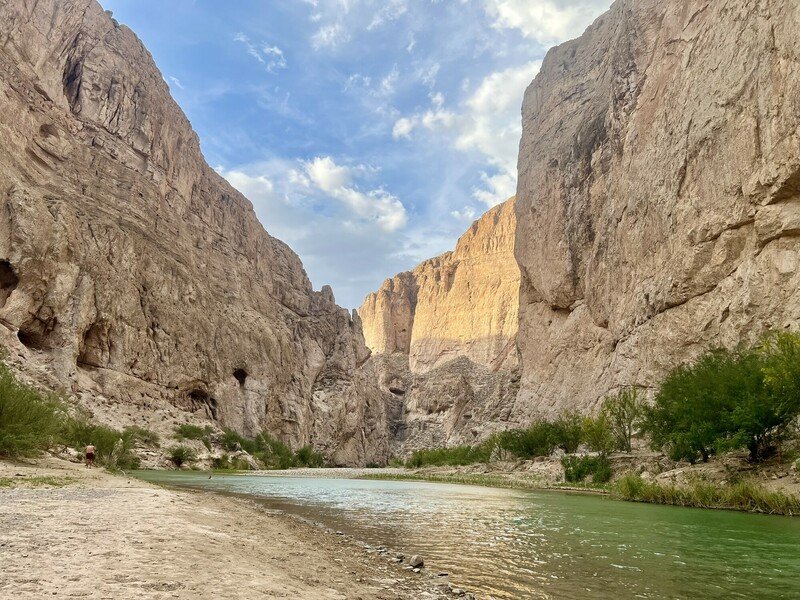
Big Bend National Park spans more than 800,000 acres of Chihuahuan Desert, rugged mountains and Rio Grande river corridor, with a southern boundary that forms more than 100 miles of the U.S.-Mexico border.
For decades, the National Park Service has managed border immigration activities there while preserving the irreplaceable natural and historic values that draw over half a million visitors each year. New barriers, associated infrastructure and patrol roads through this region would damage roadless canyon country, impede river access, fragment wildlife habitat and flood one of America's darkest night skies with artificial light.
Customs and Border Protection has refused to provide information regarding its construction plans in the Big Bend sector. In April the Center filed a lawsuit under the Freedom of Information Act to obtain public records about construction plans in the area.
The administration’s push to wall off the Big Bend region comes as migrant apprehensions along the southern border have fallen to historic lows. The 500-mile Big Bend Sector accounts for just 1.3% of total apprehensions nationwide and a newly released document shows that Big Bend National Park accounted for just 0.045% of total apprehensions in 2025.
In May seven former superintendents of Big Bend National Park wrote a letter urging the Department of Homeland Security not to waive laws within the national park. In March more than 130 organizations, outfitters and rural Texas businesses urged Congress to block federal funding for border wall construction in the Big Bend region.
The plaintiffs are represented by attorneys at the Center for Biological Diversity and Texas Civil Rights Project.
The Center for Biological Diversity is a national, nonprofit conservation organization with more than 1.8 million members and online activists dedicated to the protection of endangered species and wild places.
