
For Immediate Release, October 14, 2026
|
Contact: |
Nathan Donley, Center for Biological Diversity, (971) 717-6406, [email protected] |
Lawsuit Challenges Trump EPA’s Failure to Cut Pesticide Pollution in Waterways, Drinking Water
WASHINGTON— Conservation and public health groups filed a lawsuit today to force the Trump administration to develop required water quality standards for atrazine, a cancer-linked pesticide found at dangerous levels in thousands of U.S. waterways and in drinking-water supplies.
“We’re taking the Trump administration to court because it’s refusing to protect Americans from the well-documented dangers of the cancer-linked, hormone-disrupting pesticide atrazine,” said Nathan Donley, environmental health science director at the Center for Biological Diversity. “The rest of the world is banning this incredibly dangerous pesticide. Why is Trump’s EPA continuing to push this poison on people?”
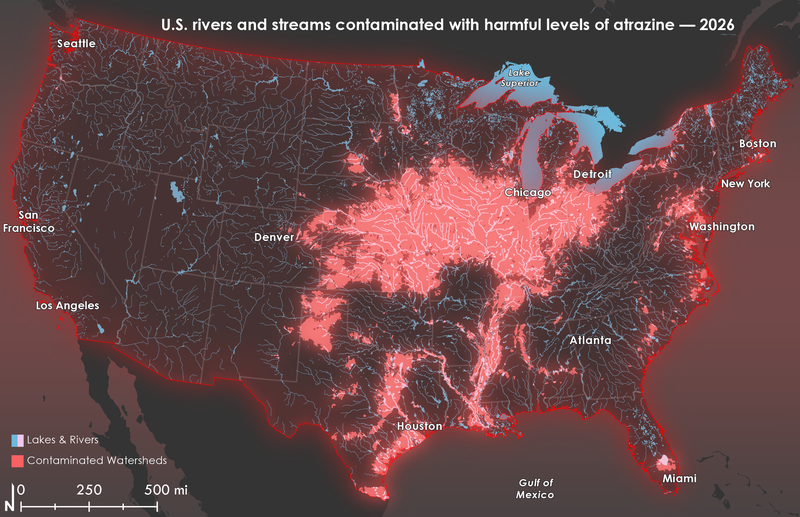
Atrazine is the nation’s most widespread pesticide water pollutant. According to a new Center for Biological Diversity report, the pesticide contaminates 25% of all river miles in the continental United States at levels the Environmental Protection Agency recognizes as harmful to aquatic life. Atrazine pollution is caused by industrial agricultural operations using tens of millions of pounds of the pesticide each year.
Today’s lawsuit challenges the lack of water quality protections in American waterways as required under the Clean Water Act. The Act requires the EPA to develop water quality standards for pollutants like atrazine. The agency initiated but failed to complete that step in 1999.
The EPA is moving toward reapproving the hormone-disrupting pesticide for another two decades. A recently published study found that the EPA’s proposal to continue atrazine use would leave 99% of the nation’s most contaminated watersheds polluted with the pesticide at levels that the agency itself considers unsafe.
“Protecting the environment from pesticides benefits farmworkers and farming communities suffering from these poisons polluting their water,” said Margaret Reeves, a senior scientist focused on agroecology and workers' rights at the Pesticide Action and Agroecology Network. “Building healthy soils and sustainable food systems will help us break our reliance on toxic pesticides like atrazine.”
Atrazine is banned as too dangerous in more than 60 countries but is the second most widely used pesticide in the United States, behind glyphosate. It is linked to birth defects, multiple cancers, and fertility problems like low sperm quality and irregular menstrual cycles.
California health officials proposed to list atrazine as known to cause cancer earlier this month following the 2025 decision by the World Health Organization’s International Agency for Research on Cancer finding that atrazine is probably carcinogenic. Scientific research has found it chemically castrates male frogs at extremely low concentrations, including those allowed in drinking water.
“Pesticides like atrazine that are clearly linked to reproductive harms and cancer don’t belong in our water supplies,” said Tom Fox, senior legislative counsel at the Center for Environmental Health. “EPA needs to take action now as required by the Clean Water Act.”
Today’s lawsuit was filed in U.S. District Court in the Northern District of California by the Center for Biological Diversity, Pesticide Action & Agroecology Network, and the Center for Environmental Health.
Background
The troubling health harms of atrazine, as well as glyphosate, were spotlighted in the Trump administration’s first Make American Healthy Again report. Atrazine has been a priority pesticide for public health advocates for decades because of the extreme threats it poses to human health and the environment.
During the first Trump administration, the EPA discarded safety precautions mandated under the Food Quality Protection Act that protect young children from pesticide exposures. In doing so the agency ignored multiple independent epidemiological studies finding that developing embryos and young children are at a high risk of harm from this pesticide.
The EPA also reduced the protection factor it used to convert toxicity levels observed in rat and mouse studies to levels considered safe for humans. The more permissive benchmark relied on a model developed by the primary manufacturer of atrazine, Syngenta.
Had the science-based, more-protective standards been used, atrazine use on lawns and turf would likely have been banned because of unacceptable harms to children. But the agency only proposed a modest reduction in application rates for turf.
The Trump administration also weakened environmental safeguards put in place in 2006 to protect aquatic life from harmful atrazine exposure, a move that increased the amount of atrazine allowed in waterways across the United States. The change came in response to requests from the pesticide’s maker, Syngenta, and the National Corn Growers Association.
Atrazine has saturated much of the country at levels that the EPA recognizes will harm wildlife.
Atrazine is primarily used on corn grown for animal feed and ethanol. The U.S. Department of Agriculture reports that ethanol production accounts for nearly 45% of total corn use; 40% of domestic corn use is for livestock feed; and some portion of the remainder is processed into ingredients used in ultra-processed foods, like high fructose corn syrup, glucose, dextrose and corn oil.
The Center for Biological Diversity is a national, nonprofit conservation organization with more than 1.8 million members and online activists dedicated to the protection of endangered species and wild places.
