
For Immediate Release, February 4, 2026
|
Contact: |
Lisa Belenky, (415) 385-5694, [email protected] |
Lawsuit Challenges Illegal Highway Through Utah’s Red Cliffs National Conservation Area
WASHINGTON— Six local, Utah-based and national conservation groups sued the Bureau of Land Management and U.S. Fish and Wildlife Service today for illegally reapproving the four-lane Northern Corridor Highway through the Red Cliffs National Conservation Area near St. George, Utah.
Today’s lawsuit comes after the Utah Department of Transportation started ground-disturbing activities using interim authorizations and despite the BLM not yet approving a required highway development plan for public lands managed by the agency.
“Preservation of Red Cliffs National Conservation Area is inextricably linked to the quality of life and economic prosperity in Washington County,” said Stacey Wittek, Conserve Southwest Utah’s executive director. “Our community has repeatedly made clear that better traffic solutions exist and that they oppose a highway through what should be protected lands. Given that UDOT is wasting no time moving forward with ground-distributing activities, we had to act to stop this illegal project.”
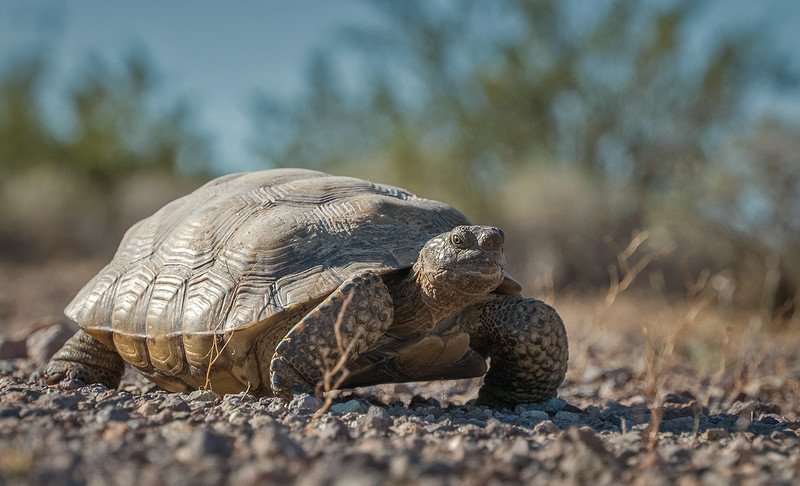
The proposed Northern Corridor Highway would carve a high-speed highway through designated critical habitat for the threatened Mojave desert tortoise within Red Cliffs National Conservation Area. It would damage iconic redrock landscapes, disrupt treasured outdoor recreation opportunities, and set a dangerous precedent for congressionally protected public lands across the U.S.
Today’s lawsuit, filed by Advocates for the West in the U.S. District Court for the District of Columbia, challenges federal agencies’ January 2026 reapproval of Utah’s highway proposal for violating multiple federal laws, including the Omnibus Public Land Management Act, Land and Water Conservation Fund Act, Endangered Species Act and National Environmental Policy Act.
Abandoning their previous scientific findings, the federal agencies’ recent decision reversed a December 2024 rejection of the same proposal by the BLM and Fish and Wildlife Service and marks the eighth time the controversial highway has been considered. The project has been stopped seven times over concerns related to wildlife, public safety, legal compliance and community opposition.
“To continue to push for a widely rejected and illegal highway and expect a different result is a waste of everyone’s resources,” said Hannah Goldblatt, staff attorney at Advocates for the West and counsel for the conservation groups. “And once again, federal agencies are complicit in the effort by approving the paving of this congressionally protected, sensitive, scenic landscape, not only violating bedrock environmental laws but undermining the integrity of protected public lands nationwide. We won’t let it happen.”
Statements from local residents and Utah-based and national conservation organizations:
“This lawsuit, like the last one, is necessary because our local governments have declined to engage their constituents in an open community dialogue — one that could more clearly define the problem, address its related impacts, and explore alternative solutions that have been consistently ignored. They have left their constituents with no choice, but it’s never too late to talk,” said St. George resident Tom Butine.
“What makes this decision especially troubling is that conditions on the ground have changed. The latest, but incomplete publicly available data for 2025 indicates a mortality of 26% in the RCDR,” said Professor Marshall Topham of Utah Tech University. “This number is likely to increase as the survey data analysis is completed. This is a catastrophic number for a long-lived species that depends on high adult survival to persist. Approving a new highway through the heart of the reserve where the highest density of tortoises resides ignores biological reality. Roads fragment habitat, increase predation, promote invasive species, disrupt wildlife movement, and inevitably lead to additional mortality, no matter how many fences or crossings are provided.”
“The Trump administration’s about-face is cynical and cruel, and this lawsuit shows it’s also unlawful. The Bureau of Land Management’s decision will allow Utah to bulldoze through a protected conservation area and build another highway feeding urban sprawl,” said Lisa Belenky, a senior counsel at the Center for Biological Diversity. “This beloved natural refuge has some of the last best desert tortoise habitat in Utah and was set aside because it’s essential for the tortoises to survive and thrive into the future. These public lands should be kept wild and open for fragile wildlife and everyone who loves Red Cliffs.”
“When Congress designated Red Cliffs as a National Conservation Area, that was a promise to the American people that this landscape would be protected forever,” said Chris Hill, chief executive officer of the Conservation Lands Foundation. “Allowing a four-lane highway to bulldoze through a congressionally protected National Conservation Area betrays that promise, obliterates the very concept of permanent protection and puts every single acre of America’s protected public lands directly in harm’s way. Today it’s Red Cliffs. Tomorrow it could be any of the millions of acres of protected public lands Americans and rural communities depend on. We won't let that happen, and we will fight this decision with everything we have.”
“The Red Cliffs National Conservation Area is a shared public treasure that should continue to be managed for the purposes for which it was established by Congress in 2009: ‘to conserve, protect and enhance for the benefit and enjoyment of present and future generations the ecological, scenic, wildlife, recreational, cultural, historical, natural, educational and scientific resources of the National Conservation Area’ and ‘to protect each species that is located in the National Conservation Area.' Bulldozing a four-lane highway through this landscape would permanently destroy these irreplaceable resources and deny us the freedom to continue enjoying them,” said Gregg DeBie, senior staff attorney at The Wilderness Society.
“Red Cliffs is exactly the kind of landscape Congress intended to protect when it created the National Conservation Area system — spectacular red rock country that provides critical habitat for the Mojave desert tortoise and space for people to experience the quiet and beauty of wild Utah,” said Kya Marienfeld, wildlands attorney with the Southern Utah Wilderness Alliance. “The Bureau of Land Management’s decision to greenlight a four-lane highway through the heart of this protected area defies both the law and common sense. Utahns have fought for decades to ensure that public lands like Red Cliffs remain intact for future generations, and we won’t stand by while that promise is broken.”
“This is narrow-minded, short-term thinking, and the BLM has clearly caved to local and state political pressure with this decision,” said Chris Krupp, public lands attorney for WildEarth Guardians. “It is impossible to square the agency’s legal obligation to ‘conserve, protect, and enhance’ the Red Cliffs National Conservation Area with its decision to approve a new highway through the heart of the NCA. If this project isn’t halted it will decimate one of the last strongholds of the Mojave desert tortoises in the mistaken belief that it will shorten commute times,”
Background
In a decades-long fight, local residents, conservation organizations and outdoor recreationists have strongly opposed the Northern Corridor Highway. Despite the immense local opposition, the BLM and Fish and Wildlife Service approved a right-of-way for the highway in the final days of the first Trump administration. Conservation groups sued, saying the approval violated multiple federal laws.
The case resulted in a 2023 legal agreement, which the BLM’s recent reapproval violates, and a federal court decision sending back the project’s 2021 right-of-way approval for reconsideration. Agencies acknowledged that the approval did not comply with the National Historic Preservation Act and required additional environmental analysis in light of recent wildfires that further degraded Mojave desert tortoise habitat and native vegetation. After updating its environmental analysis, the BLM again rejected the project in late 2024.
The agency’s 2024 Supplemental Environmental Impact Statement found the project would increase wildfire probability and frequency, permanently eliminate designated critical tortoise habitat, spread noxious weeds and invasive plants, and harm more cultural and historical resources than any alternative considered.
In October 2025 the BLM said it would reconsider the application after the Utah Department of Transportation argued that the federally endorsed alternative was economically infeasible, despite documented environmental and community costs associated with the Northern Corridor.
The 44,724-acre Red Cliffs National Conservation Area is part of the larger Red Cliffs Desert Reserve, which is jointly managed by the BLM, the Fish and Wildlife Service, the state of Utah, Washington County and local municipalities. The reserve was established under a 1995 Habitat Conservation Plan as a compromise to protect roughly 61,000 acres of public lands for the threatened Mojave desert tortoise while allowing development on about 300,000 acres of state and private land. Congress designated the Red Cliffs National Conservation Area in 2009 to “conserve, protect, and enhance…ecological, scenic, wildlife, recreational, cultural, historical, natural, educational, and scientific resources” of the public lands within the unit.
The region supports key populations of the threatened Mojave desert tortoise and other at-risk plants and animals, including Gila monsters, burrowing owls and kit fox. Researchers say the Mojave desert tortoise is on a path to extinction, and its habitat in Southwest Utah –– which houses some of the densest tortoise populations –– is especially vulnerable amid rapid growth in the region.
Located about 45 miles from Zion National Park, the conservation area includes 130 miles of trails, two wilderness areas, heritage public use sites, Native American cultural artifacts, several threatened or endangered species and one of Utah’s most popular state parks, Snow Canyon State Park. Visitors come from around the world to hike, mountain bike, rock climb, horseback ride, photograph and marvel at the expansive red rock landscape.
The Center for Biological Diversity is a national, nonprofit conservation organization with more than 1.8 million members and online activists dedicated to the protection of endangered species and wild places.
