
For Immediate Release, November 6, 2026
|
Contact: |
Alex Olivera, Center for Biological Diversity, +1 (202) 849-8403, [email protected] |
Lawsuit Aims to Halt Mexico’s Vaquita Protections Rollback
Mexico Failed to Consult Public on Risk to Critically Endangered Porpoises
MEXICALI, Mexico— The Center for Biological Diversity, Comarino and Greenpeace México filed a constitutional challenge to Mexico’s latest fishing rules for the Upper Gulf of California. The amended regulation opens vast new areas of vaquita habitat to the deadly gillnets that have driven these small porpoises to the brink of extinction.
“The government made a decision with potentially catastrophic consequences for the vaquita without giving the public a meaningful chance to examine the proposed boundaries and respond,” said Alex Olivera, Mexico representative at the Center for Biological Diversity. “With only about 10 of these little porpoises left, Mexico should be enforcing rules in the vaquita’s entire habitat, not legalizing gillnets in waters that should be protected. Vaquitas don’t follow maps, and scientists have repeatedly seen them outside the zero tolerance area.”
The lawsuit asserts that the government adopted these sweeping changes without an open public consultation. The groups are asking the court to suspend the new rules while it hears the case.
“The reform of October 14, 2026, considerably reduces the area where the use of gillnets is prohibited, thereby weakening the protection of the vaquita,” said Ilse Vázquez Maldonado, a lawyer and activist. “This reduction comes on top of more than six years of omissions. Since the adoption of the 2020 agreement, the authorities have not guaranteed effective compliance with the ban nor the installation of monitoring systems on all fishing vessels subject to this obligation. The persistence of these omissions, along with the reduction of the protected area, exacerbates the risk of extinction for the species and raises a question of responsibility for the Mexican state.”
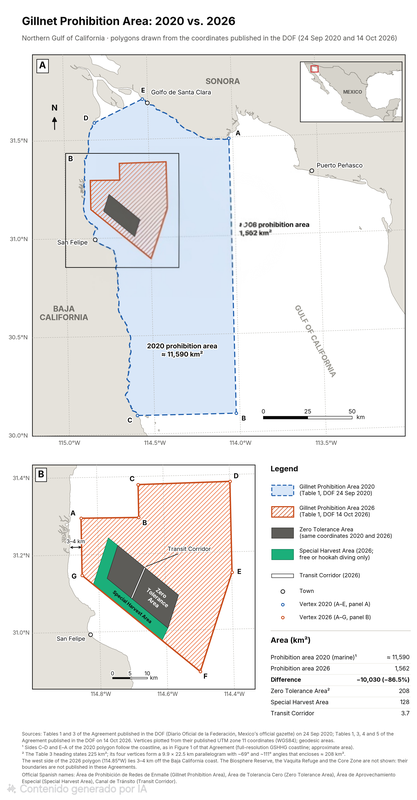
The new regulations shrink the area where gillnets are prohibited by approximately 86% compared with previous protections adopted in September 2020. This results in removing the gillnet ban from thousands of square kilometers of the vaquita’s historical habitat.
Vaquitas face one primary threat: They become entangled and drown in gillnets used to catch shrimp and totoaba, an endangered fish whose swim bladder is trafficked primarily to Asia. Scientists estimate that only about 10 vaquitas remain, down from nearly 600 in 1997.
The lawsuit says that before publishing the new rules Oct. 14, the government did not give the public time to review the full proposal or a formal opportunity to submit comments. The groups say that failure conflicts with Mexico’s commitments under the Escazú Agreement, which calls for open, inclusive participation in environmental decisions while they can still be influenced.
Mexico’s new regulations also fail to extend the full protections of the Zero Tolerance Area — no fishing and no vessel traffic — to a key area to the northwest, where vaquitas were seen in 2025 and 2026. Vaquita experts from the Comité Internacional para la Recuperación de la Vaquita (CIRVA) urged Mexico to protect those waters immediately and install concrete blocks with hooks that deter gillnets, but that area still lacks blocks.
“CIRVA indicated to the government exactly where additional protection was urgently needed,” said Yolanda Alaniz, a scientific consultant with Comarino. “The public should have had the opportunity to examine the maps, the scientific evidence, and the risks to the vaquita before these provisions came into effect. Not only is the area being reduced, but it is being divided in half by a navigation channel. This amounts to the fragmentation of their habitat.”
The new regulations also open a 350-meter-wide vessel transit corridor through the Zero Tolerance Area, where fishing and vessel traffic had previously been prohibited. Although satellite vessel tracking is already under way and was installed after the shrimp season started, the new regulations postpone the requirement for 12 months and make it subject to budget approval. The groups say these changes undermine efforts to stop illegal gillnet fishing and totoaba trafficking.
“Fishing communities need long-term sustainable livelihoods and fishing methods that are safe for vaquitas,” said Aleira Lara, executive director of Greenpeace Mexico. “We agree that fishing communities, like everyone else, have the right to a dignified life, but this does not require sacrificing this species. The Mexican government must address its social justice debt without harming the environment. If fishing communities had the support they needed to transition to sustainable fishing methods, and their basic needs were met, it would not be necessary to allow this species to be put at risk. The public also needs decisions to be made transparently and with the participation of all those affected. The court has the power to stop this erosion before more of the habitat is exposed to deadly nets.”
The Center for Biological Diversity is a national, nonprofit conservation organization with more than 1.8 million members and online activists dedicated to the protection of endangered species and wild places.
Conservación de Mamíferos Marinos de México (Comarino) is a Mexican nonprofit organization dedicated to the conservation and protection of marine mammals, both in the wild and in captivity, and of the habitats they depend on.
Greenpeace México is part of a global environmental movement that is politically and economically independent. It investigates, exposes and campaigns against environmental harm, working for respect for nature, justice and peace. Greenpeace México does not accept money from governments, political parties or corporations.
