
For Immediate Release, July 20, 2026
|
Contact: |
Ragan Whitlock, Center for Biological Diversity, (727) 426-3653, [email protected] |
Florida Lizard, Two Snakes Win First Endangered Species Protections of Trump’s Second Term
ST. PETERSBURG, Fla.— Following legal pressure and more than a decade of advocacy by the Center for Biological Diversity, the U.S. Fish and Wildlife Service today protected the Florida Keys mole skink, the Rim Rock crowned snake and Key ringneck snake as endangered species.
Until today, the Trump administration had not listed a single new species under the Endangered Species Act during its second term — the longest any administration had gone without protecting a species in the more than 50-year history of the law while hundreds of species are waiting for protection.
Despite listing the three species as endangered, the Service failed to concurrently issue lifesaving critical habitat protections.
“Protecting these creatures as endangered because of habitat destruction and then refusing to protect the places they live is like admitting someone to the emergency room for a heart attack and then refusing to treat them,” said Ragan Whitlock, an attorney at the Center for Biological Diversity. “It’s reckless and irresponsible. Doubly so now that the Trump administration has gutted regulations meant to protect species from harm caused by habitat destruction.”
Protections for the rare reptiles came after the Center, represented by the Jacobs Public Interest Law Clinic for Democracy and the Environment at Stetson University College of Law, reached a legal agreement requiring the agency to make a final determination by July 16.
“A decision that lists species but fails to protect the places those species need to survive runs counter to logic and science,” said Rachael Curran, a staff attorney at the Jacobs Public Interest Law Clinic for Democracy and the Environment at Stetson University College of Law. “The Fish and Wildlife Service’s job half done leaves these rare reptiles without full protections right when they need them most.”
The lizard and snakes waited more than 10 years for a proposal to protect them under the Endangered Species Act, and then another four to receive the protections. During that time, they continued to face unmitigated threats.
The rare reptiles face extinction-level threats from habitat-destroying development and sea-level rise, which continue to close in on the few remaining places they call home. Their habitat on the low-lying Big Pine Key is particularly vulnerable to sea level rise and development.
Whether these threats are addressed is an open question. Last week, the Trump administration issued a rule that attempts to gut habitat protections by rescinding a long-standing definition of the word “harm” in the statute that prohibited actions that destroyed or degraded the places where plants and animals live.
Species Highlights
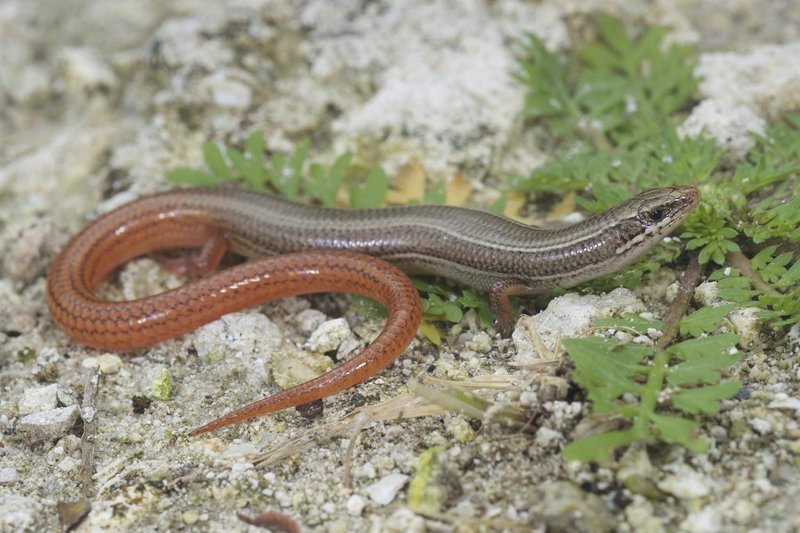
Florida Keys mole skink: Adorned with a bright-pink tail, the Florida Keys mole skink lives along shorelines in the Florida Keys. These reptiles burrow in dry sand and hunt insects under leaves, debris and washed-up vegetation on beaches. Accelerating sea-level rise and storms of increasing intensity threaten to inundate the skink’s remaining coastal habitat. Because the animals survive in only a few populations across a small geographic area, a single major storm could wipe out the whole subspecies. Urban sprawl is also squeezing the skinks into increasingly smaller areas, while exposing them to threats from pollution, traffic and feral animals. Following a Center petition in 2010, the Service delayed and then denied protections for the lizard in 2017. But following a Center legal victory in 2020, the Service proposed to protect this skink as a threatened species in 2022.
Key ring-necked snake: Small and nonvenomous, the Key ring-necked snake grows to be approximately 6 inches long. They have a slate gray back with a surprisingly bright yellow to red belly and a muted or entirely missing orange neck ring. Key ring-necked snakes live only in the Florida Keys. Following a Center petition in 2012 and a legal victory in 2022, the Service proposed to protect the snakes in 2022.
Rim Rock crowned snake: Named after the Miami Rim Rock geological formation, the small, nonvenomous Rim Rock crowned snake grows up to 10 inches long. These snakes live in critically endangered pine rockland and tropical hardwood forests around Miami and the Florida Keys, where they can be found hiding in holes and depressions in limestone rock. Following a Center petition in 2012 and a legal victory in 2022, the Service proposed to protect the snake in 2022.
The Center for Biological Diversity is a national, nonprofit conservation organization with more than 1.8 million members and online activists dedicated to the protection of endangered species and wild places.
Recognizing that the health of our environment and of our communities are inextricably linked, and entirely dependent on a functioning and just democracy, the Jacobs Public Interest Law Clinic pursues and defends justice through advocacy focused on Florida’s most pressing environmental issues.
