
For Immediate Release, September 24, 2026
|
Contact: |
Nathan Donley, (971) 717-6406, [email protected] |
Analysis: Atrazine Pollutes 25% of River Miles in Continental U.S. at Levels Known to Harm Wildlife
Dangerous Levels of Pesticide Found in Waterways Millions Use For Drinking Water
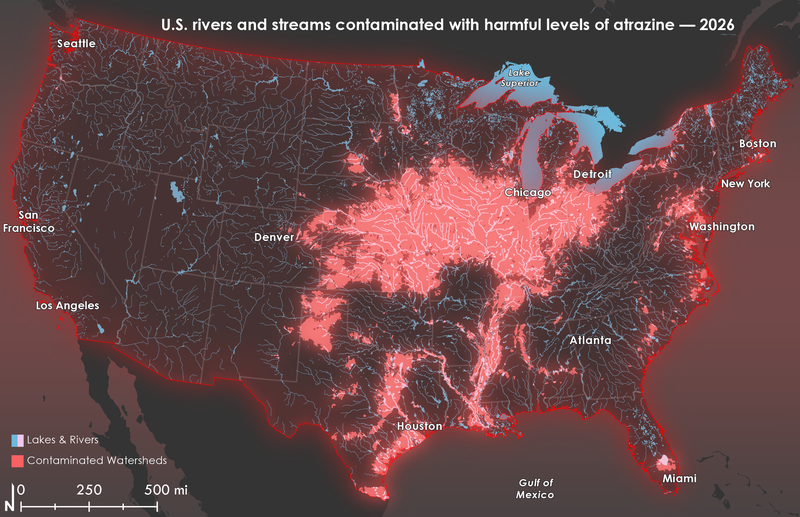
WASHINGTON— Levels of the hormone-disrupting pesticide atrazine known to harm aquatic wildlife are estimated to contaminate more than 25% of all river and stream miles in the lower 48 states — nearly 860,000 miles, according to a new analysis by the Center for Biological Diversity.
“One quarter of our rivers and streams are being treated like a sewer by corporate agriculture,” said Nathan Donley, environmental health science director at the Center for Biological Diversity. “Just one pesticide is single-handedly polluting vast expanses of our nation’s waterways at levels that endanger people and wildlife. It’s an absolute travesty.”
The analysis, which assessed Environmental Protection Agency water contamination data, also found that dangerous levels of atrazine pollute waterways relied on by more than 20% of U.S. surface-water treatment facilities, reservoirs and water intakes that provide water for people to drink, bathe and prepare food.
Today’s report identified five hotspots with some of the highest levels of atrazine contamination in the country: Chesapeake Bay, Midwest Corn Belt, Florida’s Lake Okeechobee, lower Mississippi River and Texas Gulf Coast. Millions of people in these regions are served atrazine-contaminated water by their public water utility.
The areas where waterways are highly contaminated with atrazine also contain at least 675,000 wells currently supplying potable water to homes and businesses, including hotels, restaurants and office buildings.
More than 70 million pounds of atrazine are sprayed on crops each year and it is the most widely detected pesticide contaminant in U.S. rivers, streams and below-ground water supplies. It is a known hormone-disrupting pesticide linked to birth defects, multiple cancers, and fertility problems like low sperm quality and irregular menstrual cycles.
Because of those well-documented health concerns, atrazine has been banned in more than 60 countries. Yet the EPA is in the process of reapproving its use in the United States for at least another 15 years.
“We need to follow the lead of over 60 countries around the world and ban atrazine once and for all,” said Donley. “Failing to do so will mean disease, death and dirty water in America for decades to come.”
In the Chesapeake Bay, more than 5.5 million acres of the bay’s watershed — encompassing over 15,000 river miles — is contaminated with atrazine at levels higher than those known to harm aquatic ecosystems. That area is home to 18 million people and more than 3,600 species of plants and animals.
In the Midwest Corn Belt, encompassing Kansas, Nebraska, Iowa, Missouri, Illinois, Indiana and Ohio, more than two thirds of the total river miles are contaminated with dangerous levels of atrazine. This includes over half of the region’s wells and 68% of the region’s drinking-water treatment facilities that source from surface water.
Florida’s 730-square-mile Lake Okeechobee is surrounded by 500,000 acres of nearby sugarcane fields, which are heavily sprayed with atrazine. The lake is visited by thousands of people each year for boating and fishing.
Atrazine-contaminated watersheds run nearly the entire length of the lower Mississippi River, many at concentrations more than five times the level the EPA has found harmful to aquatic ecosystems. This poses a threat not only to wildlife but to the 20 million people who rely on the river for their drinking water. Water from more than 40% of the continental United States flows down the Mississippi River to the Gulf of Mexico.
The Texas Gulf Coast from Corpus Christi to Galveston is a vital region for migrating birds, aquatic wildlife and recreational activities like swimming, boating and fishing. More than 6 million acres in this region, covering more than 6,000 river miles, are contaminated with atrazine levels that can harm aquatic wildlife. Texas is the state with the most public water utilities reporting atrazine contamination, with nearly 15 million people in the state drinking atrazine-contaminated water.
The Center for Biological Diversity is a national, nonprofit conservation organization with more than 1.8 million members and online activists dedicated to the protection of endangered species and wild places.
