
For Immediate Release, February 4, 2026
|
Contact: |
Elise Bennett, Center for Biological Diversity, (727) 755-6950, [email protected] |
11 South Florida Species Move Closer to Endangered Species Protection
Snakes, Lizards, Plants at Risk From Sea-Level Rise, Development
ST. PETERSBURG, Fla.— The Center for Biological Diversity, represented by the Jacobs Public Interest Law Clinic for Democracy and the Environment at Stetson University College of Law, has reached a legal agreement that moves 11 Florida species closer to Endangered Species Act protections.
The agreement with the U.S. Fish and Wildlife Service requires the agency to make final protection determinations for the Florida Keys mole skink, Rim Rock crowned snake and Key ring-necked snake by July 16, 2026, and final habitat protections for eight rare south Florida plants by Jan. 20, 2027.
Three of these plants are imperiled by the construction and operation of the federal detention center known as “Alligator Alcatraz.”
“This is a clear example of why we need timely protection for Florida’s rare plants and animals and the places they live. Without it, some of their most important habitat could be wiped out with no one the wiser,” said Elise Bennett, Florida and Caribbean director at the Center for Biological Diversity. “I’m looking forward to the Fish and Wildlife Service finalizing these proposals. Meanwhile we’re doing everything we can to keep these flamboyant lizards, diminutive snakes and Florida-native plants from sliding closer to extinction.”
The 11 imperiled South Florida species face extinction-level threats from habitat-destroying development and sea-level rise, which continue to close in on the few remaining places they call home. The Service proposed granting urgently needed protections for the animals and plants but missed the mandatory deadlines to finalize those protections.
While the species waited, the Trump and Gov. Ron DeSantis administrations began building and operating an immigration detention center in the Everglades. This so-called “Alligator Alcatraz” was built amid proposed critical habitat for three of the imperiled plants without any environmental review or precautions.
“These rare plants and reptiles don’t live anywhere else on Earth,” said Rachael Curran, staff attorney at the Jacobs Public Interest Law Clinic for Democracy and the Environment at Stetson University College of Law. “Our clinic students work hard to ensure that we are doing everything we can to help protect remaining south Florida habitat.”
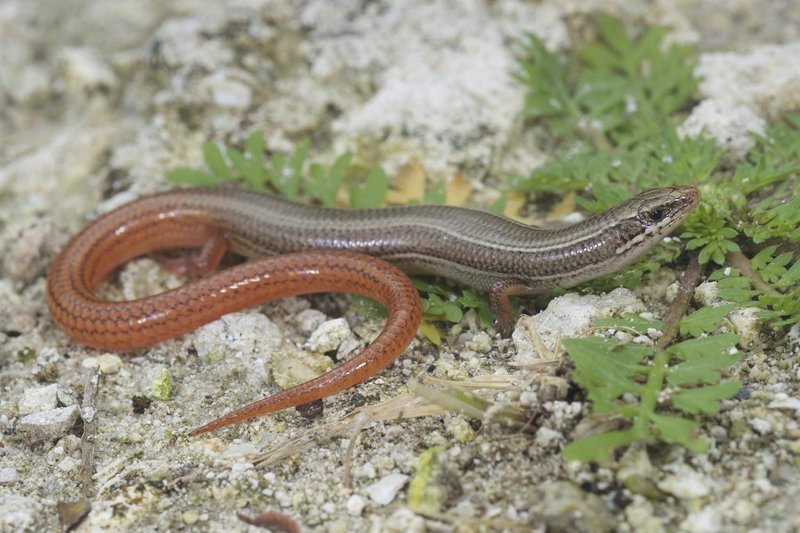
In September 2022 the Service proposed protecting the Florida Keys mole skink, a smooth, shiny lizard with a bright pink tail, as threatened and also proposed designating 7,068 acres of protected critical habitat. Rapid and intense shifts in climate, development and associated human activities threaten the rare lizard’s survival.
In October 2022 the Service proposed to protect two small, nonvenomous snakes — the Key ring-necked snake and Rim Rock crowned snake — as endangered and to protect 2,604 acres and 5,972 acres of critical habitat for the snakes, respectively. Recognizing existential threats from urban sprawl and sea-level rise fueled by climate change, the Service projected that virtually no habitat for either species will remain in the lower Florida Keys by 2080.
Also in October 2022 the Service proposed to protect 179,680 acres of critical habitat for the Everglades bully, 177,879 acres for the Florida pineland crabgrass, 8,867 acres for the pineland sandmat and 179,300 acres for the Florida prairie clover in Monroe, Collier and Miami-Dade counties.
In a separate decision, the Service proposed to protect 1,462 acres for the Big Pine partridge pea and 1,379 acres for the wedge spurge in Monroe County, as well as 5,090 acres for the sand flax, and 16,635 acres for the Blodgett’s silverbush in Miami-Dade and Monroe counties.
All eight plants can be found in the few remaining pockets of pine rockland habitats, which have been reduced by at least 98% over recent decades.
The Endangered Species Act prohibits federal agencies from authorizing activities that will destroy or harm a protected species’ critical habitat. Species with federally protected critical habitat are more than twice as likely to be recovering as species without it.
Species Highlights
Florida Keys mole skink: Adorned with a bright-pink tail, the Florida Keys mole skink lives along shorelines in the Florida Keys. These reptiles burrow in dry sand and hunt insects under leaves, debris and washed-up vegetation on beaches. Accelerating sea-level rise and storms of increasing intensity threaten to inundate the skink’s remaining coastal habitat. Because the animals survive in only a few populations across a small geographic area, a single major storm could wipe out the whole subspecies. Urban sprawl is also squeezing the skinks into increasingly smaller areas, while exposing them to threats from pollution, traffic and feral animals. Following a Center petition in 2010 and a legal victory in 2020, the Service proposed to protect this skink as a threatened species in 2022.
Key ring-necked snake: Small and nonvenomous, the Key ring-necked snake grows to be approximately 6 inches long. They have a slate gray back with a surprisingly bright yellow to red belly and a muted or entirely missing orange neck ring. The Key ring-necked lives only in the Florida Keys. Following a Center petition in 2012 and a legal victory in 2022, the Service proposed to protect the snake in 2022.
Rim Rock crowned snake: Named after the Miami Rim Rock geological formation, the small, nonvenomous Rim Rock crowned snake grows up to 10 inches long. These snakes live in critically endangered pine rockland and tropical hardwood forests around Miami and the Florida Keys, where they can be found hiding in holes and depressions in limestone rock. Following a Center petition in 2012 and a legal victory in 2022, the Service proposed to protect the snake in 2022.
Big Pine partridge pea: The Big Pine partridge pea is a small shrub with five-petal, yellow flowers and pea-shaped fruit. They’re found only in the pine rocklands of the lower Florida Keys. The peas used to live in Big Pine Key, No Name Key, Ramrod Key, Cudjoe Key and Sugarloaf Key, but are now only found on Big Pine Key and Cudjoe Key.
Blodgett’s silverbush: The Blodgett’s silverbush is a woody shrub with small, green flowers. These shrubs grow in the pine rocklands of Monroe and Miami-Dade counties but have become increasingly rare.
Everglades bully: The Everglades bully is a shrub with spiny branches, oval leaves with fuzzy undersides and clusters of small, white flowers. It has been a candidate for protection since 2004. The shrub is native to Miami-Dade County and is only found in pine rocklands.
Florida pineland crabgrass: The Florida pineland crabgrass is also known as Everglades grass or twospike crabgrass. The crabgrass species occurs in the Everglades in Miami-Dade and Monroe counties. The crabgrass was first identified as needing endangered species protection in 1975. The Center petitioned the Service to protect the species in 2004.
Florida prairie clover: The Florida prairie clover had been waiting on the Service’s candidate list for federal protection since 1999. The clover is a member of the pea family and grows up to 6 feet tall in pine rocklands and coastal uplands.
Pineland sandmat: The pineland sandmat had been a candidate for protection since 1999. Also known as the pineland deltoid spurge, rockland spurge and wedge sandmat, the sandmat is a beautiful perennial herb with a red stem and delicate, yellow flowers.
Sand flax: The sand flax is a small, perennial herb with yellow, buttercup-looking flowers. The sand flax is found in pine rocklands in Monroe and Miami-Dade counties, and the populations are declining.
Wedge spurge: The wedge spurge is a small, perennial herb with slender stems and a silvery appearance. The wedge spurge occurs in pine rocklands and roadsides on Big Pine Key, where the population is declining.
The Center for Biological Diversity is a national, nonprofit conservation organization with more than 1.8 million members and online activists dedicated to the protection of endangered species and wild places.
Recognizing that the health of our environment and of our communities are inextricably linked, and entirely dependent on a functioning and just democracy, the Jacobs Public Interest Law Clinic pursues and defends justice through advocacy focused on Florida’s most pressing environmental issues.
