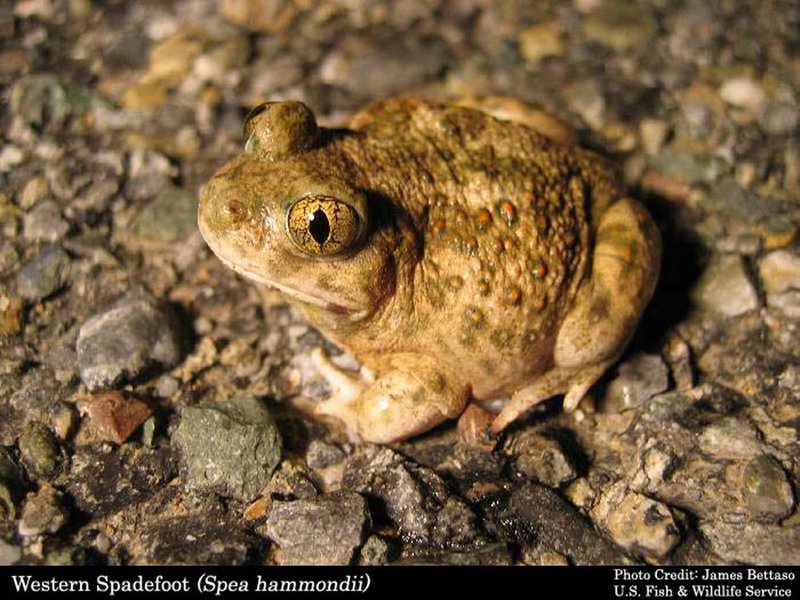
SACRAMENTO, Calif.— The California Department of Fish and Wildlife has recommended that the state wildlife commission conduct an endangered species review for the western spadefoot.
These small amphibians are found in lowlands of the Central Valley, Southern California, and coastal California, from Monterey County down to northern Baja.
This week’s recommendation is an important step toward the western spadefoot receiving protection as a candidate species under the California Endangered Species Act.
“I’m pleased that California wildlife officials have recommended further review for the struggling spadefoot,” said Sofia Prado-Irwin, Ph.D., a staff scientist at the Center for Biological Diversity. “These little amphibians are resilient, but they’re being pushed to their limits by poorly planned development and continued habitat loss across the state. They badly need the protection of the California Endangered Species Act.”
The recommendation is a response to the Center’s petition seeking state protections for the northern and southern spadefoot populations. The California Fish and Game Commission is expected to consider review at its April 16 meeting.
Western spadefoots are small, cryptic amphibians that live in grasslands and shrublands and spend much of their lives underground, emerging to breed during autumn and winter rains. They can breed in different types of water bodies, but they are particularly reliant on vernal pools — a unique type of seasonal wetland that supports an impressive variety of rare and endemic plants and animals.
Up to 95% of the state’s vernal pools have been lost, and pressure to develop remaining vernal pools remains high.
The department concluded that the Center’s petition contained sufficient evidence to potentially warrant listing western spadefoot under the California Endangered Species Act. If the commission follows the department’s recommendation, the western spadefoot will become a candidate species under the Act and will receive state protections while its status undergoes further review.
In 2023 the western spadefoot was proposed for federal protections as a threatened species under the Endangered Species Act but a final decision has not been made. Trump officials’ ongoing efforts to weaken environmental protections, including the Act, make it unlikely that western spadefoot will receive federal protections under this administration. Recent changes to weaken the Clean Water Act also make semi-aquatic species like western spadefoot particularly vulnerable.
Western spadefoots are primarily threatened by habitat loss, degradation, alteration and fragmentation as well as climate impacts including extreme drought. They are also harmed by chemical contaminants, nonnative predators, wildfire, and noise disturbance.