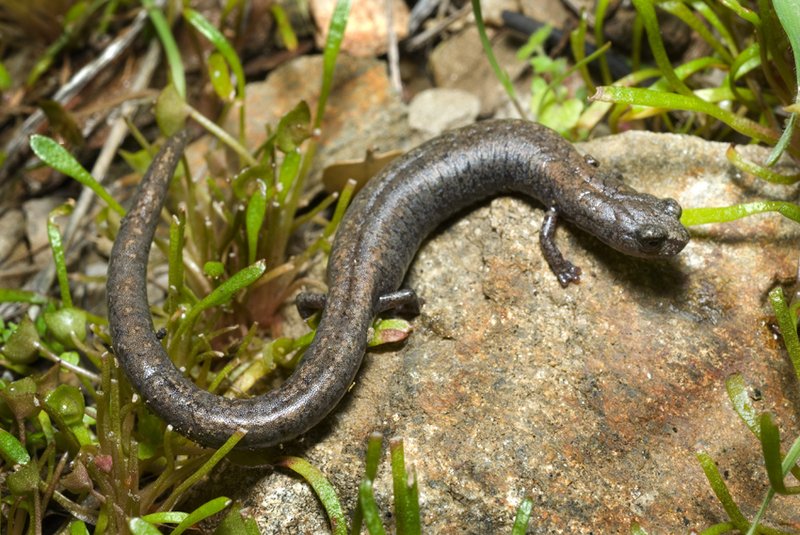
CARLSBAD, Calif.— The Center for Biological Diversity has scored a legal victory requiring the U.S. Fish and Wildlife Service to finalize Endangered Species Act protections for the critically imperiled Kern Canyon and relictual slender salamanders by December 2026.
“I’m so glad these unusual and rare salamanders will finally get badly needed Endangered Species Act protections,” said Tara Zuardo, a senior endangered species advocate at the Center. “These little amphibians help maintain the balance of forest and chaparral ecosystems in the southern Sierra Nevada and Kern River region. They could be one disaster away from extinction, so these protections are crucial for them and this stunning slice of California.”
Among California amphibians, the salamanders rank among the state's most vulnerable vertebrates because of their tiny range, loss of historical populations and susceptibility to climate-driven drying and wildfire. With small ranges in the southern Sierra Nevada, decades of livestock grazing, logging and development — including construction of the Isabella Dam and State Route 178 — have taken their toll on the species.
The Kern Canyon slender salamander is believed to survive at just nine sites and the relictual slender salamander at 12 sites. Relictual slender salamanders have been entirely lost from the Lower Kern River Canyon and could face extinction if a large wildfire or a series of severe drought years affects the remaining places where they live.
Following the Center’s 2012 legal petition, the Service proposed protecting the Kern Canyon slender salamander as threatened and the relictual slender salamander as endangered in October 2022, triggering a one-year deadline to finalize those protections. Today’s agreement resolves a March 2025 Center lawsuit over the agency’s failure to finalize those listings and provide Endangered Species Act protection for both species.
Both species of salamanders live close to water, including seeps and streams, under logs, leaf litter and rocks. They are thought to be highly sedentary, not moving far from where they were born. They’ve persisted through major climatic changes in the southern Sierra Nevada, while remaining isolated in tiny pockets of suitable habitat.
The Trump administration’s cuts to federal agencies and mass firings have made it difficult for employees to carry out their missions, which include protecting species under the Endangered Species Act. The first Trump administration protected the lowest number of species of any president since the law went into effect in 1973, and the second Trump administration has yet to protect any U.S. species.