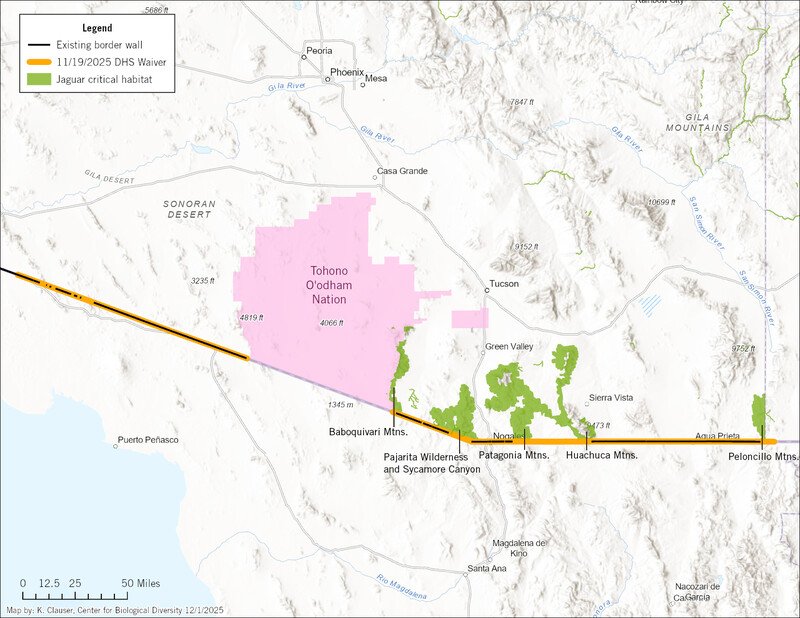
TUCSON, Ariz.— The last remaining federally designated jaguar corridors connecting the U.S. with Mexican jaguar populations will be walled off under recently released Trump administration plans, according to a new analysis from the Center for Biological Diversity.
The Center analyzed the Trump administration decision to waive a wide range of environmental, cultural-resource and public-health laws to fast-track construction of border walls and industrial-scale lighting systems across all federally designated jaguar critical habitat connecting southeastern Arizona to Mexico.
The waivers, issued Nov. 19, clear the way for hundreds of miles of border infrastructure — including dual-layered walls, patrol roads, industrial lighting, underground fiber-optic cables and surveillance infrastructure — with construction targeted at intact wildlife corridors used by endangered jaguars, as well as ocelots and dozens of other animals moving between the U.S. and Mexico.
"This disastrous move isn’t about border security. It’s about barreling ahead with Trump’s destructive wall and shoveling billions of dollars in taxpayer money to his cronies,” said Russ McSpadden, Southwest conservation advocate at the Center. “Plowing new and secondary walls through this remote landscape would devastate jaguar recovery and seal off some of the most important wildlife corridors between Arizona and Mexico. Industrial lighting would wipe out the night itself, erasing stars and scrambling the natural rhythms of pollinators. These are catastrophic blows to jaguars, bats, migratory birds and every nocturnal animal that depends on dark, quiet habitat to survive.”
The areas targeted by the Trump administration — including the Pajarita Wilderness, Sycamore Canyon, and the Baboquivari, Patagonia, Huachuca and Peloncillo mountains — are the very landscapes federal scientists have identified as the backbone of jaguar recovery and the only pathways connecting U.S. habitat to the breeding population in Sonora.
Secondary walls — a second, parallel line of tall steel bollards — would intensify habitat fragmentation, block wildlife movement even where gaps remain in the primary barrier, and create miles of walled-in corridors where animals could get trapped.
New towers of high-intensity LED floodlights stretching across mountains, canyons and grasslands represent one of the most ecologically damaging border-infrastructure expansions ever proposed. Night lighting disrupts navigation, hunting, migration and breeding in a wide range of species and dramatically expands the zone of impact far beyond the physical footprint of the wall.
The move resurrects and intensifies the destructive practices of Trump’s previous term, when federal contractors blasted mountains, drained desert springs, bulldozed saguaros and bisected wildlife corridors to install border barriers.
Key Laws Waived by the Trump Administration
To push these projects through without scrutiny, the administration invoked Section 102 of the Real ID Act to waive dozens of bedrock laws that normally protect communities, wildlife, water, culture and human health. Among the most significant:
Administrative Procedure Act
Antiquities Act
Archaeological and Historic Preservation Act
Archaeological Resources Protection Act
Arizona–Idaho Conservation Act of 1988
Arizona Desert Wilderness Act (Sections 301(a)–(f))
Clean Air Act
Clean Water Act
Comprehensive Environmental Response, Compensation, and Liability Act
Endangered Species Act
Eagle Protection Act
Farmland Protection Policy Act
Federal Cave Resources Protection Act of 1988
Federal Land Policy and Management Act
Fish and Wildlife Coordination Act
Historic Sites, Buildings, and Antiquities Act
Migratory Bird Conservation Act
Migratory Bird Treaty Act
Multiple Use and Sustained Yield Act of 1960
National Environmental Policy Act
National Fish and Wildlife Act of 1956
National Forest Management Act of 1976
National Historic Preservation Act
National Park Service Organic Act / General Authorities Act
National Parks and Recreation Act of 1978
National Trails System Act
National Wildlife Refuge System Administration Act
National Wildlife Refuge System Improvement Act of 1997
Native American Graves Protection and Repatriation Act
Noise Control Act
Paleontological Resources Preservation Act
Safe Drinking Water Act
Solid Waste Disposal Act
Statutory provision 16 U.S.C. 450y
Wilderness Act
Wild and Scenic Rivers Act
Wild Horse and Burro Act