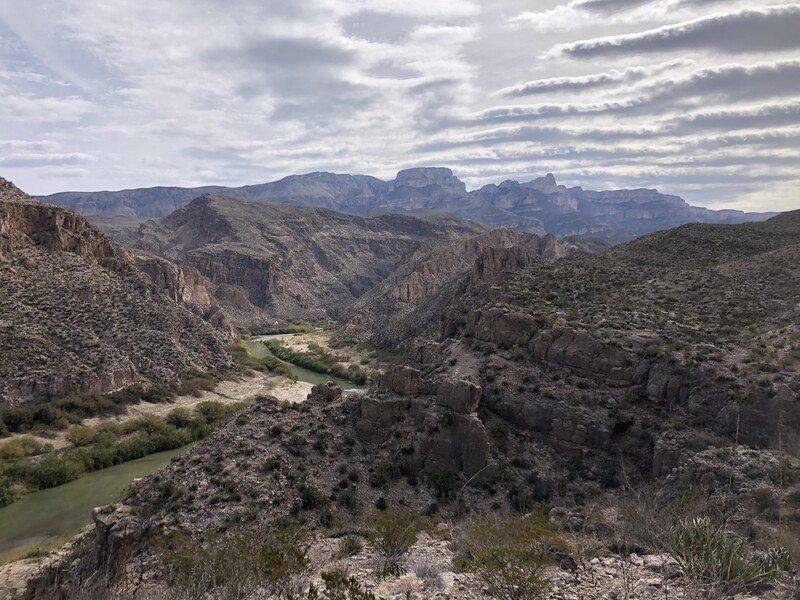
TERLINGUA, Texas— The Trump administration today waived dozens of environmental and public health laws to speed construction of border barriers and roads through approximately 60 miles of the Rio Grande Wild and Scenic River in Texas, a protected stretch running through the remote Lower Canyons of the Big Bend region.
“Congress passed the Wild and Scenic Rivers Act to protect spectacular wilderness rivers just like this very stretch of the Rio Grande. The administration’s decision to waive the act and dozens of other environmental laws lays the groundwork for the destruction of one of the wildest places in America,” said Laiken Jordahl, national public lands advocate at the Center for Biological Diversity. “The Lower Canyons of the Rio Grande are so remote that visitors can float for days without seeing a road, a light or a single sign of the modern world. It’s tragic to see the administration clear the way to blast roads through these serene canyon walls and build a massive barricade across one of the last great rivers in the American Southwest.”
Today’s waiver authorizes construction of new fencing, barriers, roads and sensors across a remote segment of the border extending east of the Black Gap Wildlife Management Area deep into the Lower Canyons toward Amistad Reservoir. This is roadless canyon country only accessible by floating for multiple days on the river.
New barriers, associated infrastructure and patrol roads through this region would damage roadless canyon country, impede river access, fragment wildlife habitat and flood one of America's darkest night skies with artificial light.
Customs and Border Protection has refused to provide information regarding its construction plans in the Big Bend sector. In April the Center filed a lawsuit under the Freedom of Information Act to obtain public records about construction plans in the area.
The affected stretch of the Rio Grande is proposed critical habitat for the federally listed Texas hornshell mussel and Salina mucket, freshwater species that depend on intact river flow, stable sediment conditions and undisturbed river habitat.
On Feb. 17 the Department of Homeland Security waived 28 environmental and cultural resource protection laws to fast-track construction in the Big Bend region — including through Big Bend Ranch State Park — and it has since awarded construction contracts for much of the work. According to local media reports, contractors have been surveying inside Big Bend National Park.
The administration’s push to wall off the Big Bend region comes even as migrant apprehensions along the southern border have fallen to historic lows. The Big Bend Sector accounts for just 1.3% of total apprehensions nationwide.
In April, the Center for Biological Diversity, Friends of the Ruidosa Church and a Big Bend-area river guide and landowner filed a federal lawsuit, represented by the Texas Civil Rights Project, saying the Department of Homeland Security is exercising powers Congress never authorized. The suit contends the waivers violate the major questions doctrine, which requires explicit congressional approval for actions with vast economic and political consequences.
In March more than 130 organizations, outfitters and rural Texas businesses urged Congress to block federal funding for border wall construction in the Big Bend region.