WASHINGTON— Conservation and public health groups filed a formal notice with Environmental Protection Agency Administrator Lee Zeldin today to force the agency to develop water-quality standards for atrazine, a cancer-linked pesticide that has been found at dangerous levels in thousands of U.S. waterways and in drinking-water supplies.
The notice comes ten days after the Trump U.S. Fish and Wildlife Service released its finalized review of atrazine, concluding that the potent endocrine disruptor does not pose an extinction risk to any threatened or endangered animals or plants. This contrasts sharply with the EPA’s 2021 finding that widespread atrazine pollution is harming more than 1,000 threatened and endangered species.
“The Trump administration has failed to do anything to adequately protect our families and most endangered wildlife from the dangers of cancer-linked and hormone-disrupting pesticides, like atrazine,” said Nathan Donley, environmental health science director at the Center for Biological Diversity. “It’s appalling that the United States is so far behind the rest of the world in banning this inherently dangerous pesticide.”
The Clean Water Act requires the EPA to develop water-quality criteria for pollutants, such as atrazine. The agency initiated that step in 1999 but never completed that requirement. The legal notice filed today by the Center for Biological Diversity, Center for Environmental Health and Pesticide Action & Agroecology Network is required before any future lawsuit.
Atrazine pollution is caused by tens of millions of pounds of the pesticide being used each year by industrial agricultural operations in the United States.
The pesticide is banned as too dangerous in more than 60 countries but is the second most widely used pesticide in the United States. It is linked to birth defects, multiple cancers, and fertility problems like low sperm quality and irregular menstrual cycles.
In 2025 the World Health Organization’s International Agency for Research on Cancer found that atrazine is “probably carcinogenic to humans.” Unlike the EPA, which relies heavily on confidential research by pesticide companies of their own products, the WHO’s scientists only include in their assessments the findings of pesticide safety studies that can be reviewed by independent scientists for validity and bias.
“Atrazine is polluting waterways throughout the United States at unsafe levels leading to health risks like cancer and birth defects,” said Tom Fox, senior legislative counsel at the Center for Environmental Health. “Pesticides like atrazine that are clearly linked to reproductive harms and cancer don’t belong in our water supplies and the EPA needs to take action now as required by the Clean Water Act.”
The troubling health harms of atrazine, as well as glyphosate, were spotlighted in the Trump administration’s first Make American Healthy Again report. And atrazine has been a priority pesticide for public health advocates for decades because of the extreme threats it poses to human health and the environment.
“The science is clear that atrazine is a threat to public health in America, especially farmworkers and agricultural communities,” said Emily Marquez, a senior scientist at Pesticide Action & Agroecology Network. “The toxic burden of pesticides like atrazine on our communities’ water is too high and we should ban its use outright.”
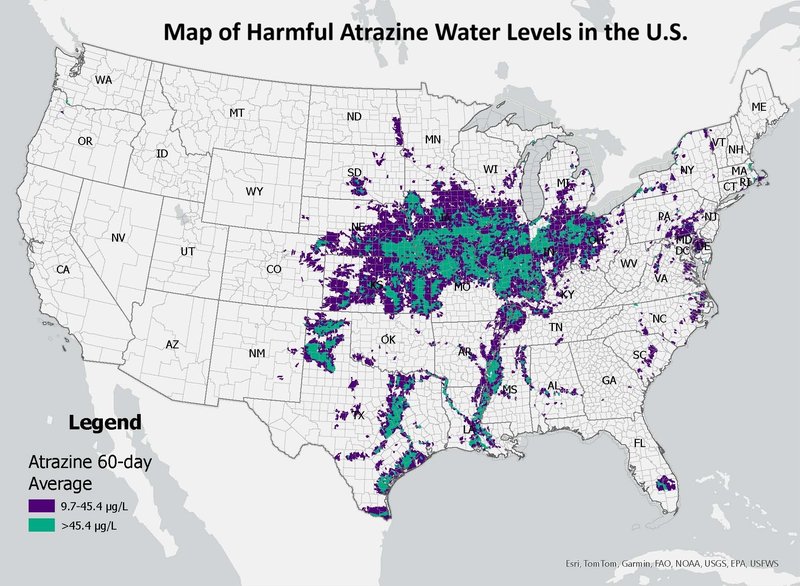
The EPA had previously proposed steps to reduce atrazine contamination in the 11,249 U.S. watersheds where atrazine levels exceed the agency’s safety threshold. A 2025 Center analysis submitted to the Trump administration found that the EPA’s plan would only bring 1% of those watersheds below levels the EPA considers harmful, leaving about one-eighth of the entire landmass of the continental United States polluted with harmful levels of the pesticide.
This follows a petition to the Trump administration to ban atrazine. Trump has stated that Health and Human Services Secretary Robert F. Kennedy Jr. is “looking into [pesticides] very seriously because maybe it's not necessary to use all of that.” Kennedy has often pointed to atrazine as among the worst pesticides and called for it to be banned.
Recent data shows that atrazine has saturated much of the country at levels that the EPA recognizes will harm wildlife.
Atrazine is primarily used on corn grown for animal feed and ethanol. The U.S. Department of Agriculture reports that ethanol production accounts for nearly 45% of total corn use; 40% of domestic corn use is for livestock feed, and some portion of the remainder is processed into ingredients used in ultra-processed foods, like high fructose corn syrup, glucose, dextrose and corn oil.