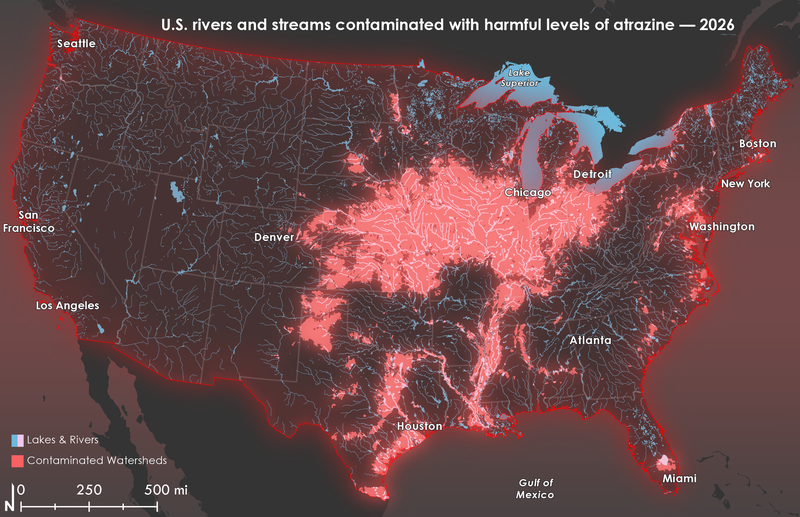
WASHINGTON— A federal plan to clean up atrazine would leave 99% of the nation’s most contaminated watersheds polluted with the pesticide at levels the Environmental Protection Agency itself considers unsafe, according to a peer-reviewed study published today in the Journal of Environmental Quality. Lakes, rivers and streams in these watersheds provide drinking water for millions of Americans.
Today’s study concluded that the EPA plan would reduce atrazine pollution to levels the agency considers safe for aquatic life in only 1% of more than 11,000 dangerously contaminated watersheds. The study also found that the plan would allow continued widespread contamination of water throughout the nation.
“A 99% failure rate is unacceptable in any context but horrific when we’re talking about an extraordinarily toxic pesticide contaminating the drinking water of millions of Americans,” said Nathan Donley, environmental health science director at the Center for Biological Diversity and lead author of the study. “The EPA can no longer hide behind this joke of a clean-up plan. Any future atrazine reapproval is direct support for decades more dirty, tainted water.”
Atrazine is the nation’s most widespread pesticide water pollutant, contaminating 25% of all river miles in the continental United States at levels the EPA recognizes as harmful to aquatic life.
The EPA’s flawed plan to reduce atrazine levels in the most dangerously contaminated rivers, lakes and streams was released by the agency as it moves toward reapproving the hormone-disrupting pesticide for another two decades.
While the effectiveness of regulatory proposals is often only determined years after they’re put into effect, this study was able to quantify how ineffective the plan will be at reducing atrazine prior to its implementation.
Banned in more than 60 countries, atrazine is the second most widely used pesticide in the United States behind only glyphosate. It is a known hormone-disrupting pesticide linked to birth defects, multiple cancers, and fertility problems like low sperm quality and irregular menstrual cycles.
Background
Atrazine was previously approved by the EPA in 2003. The agency is currently reassessing the safety of atrazine because it is required to do so every 15 years for each EPA-approved pesticide. The agency is currently significantly behind schedule but is expected to reapprove atrazine for the next few decades in 2027.
During the first Trump administration, the EPA discarded safety precautions mandated under the Food Quality Protection Act that protect young children from pesticide exposures. In doing so the agency ignored multiple independent epidemiological studies finding that developing embryos and young children are at a high risk of harm from this pesticide.
The EPA also reduced the protection factor it used to convert toxicity levels observed in rat and mouse studies to levels considered safe for humans. The more permissive benchmark relied heavily on a model developed by the primary manufacturer of atrazine, Syngenta.
Had the science-based, more-protective standards been used, atrazine use on lawns and turf would likely have been cancelled because of unacceptable harms to children. But the agency only proposed a modest reduction in application rates for turf.
The Trump administration also weakened environmental safeguards put in place in 2006 to protect aquatic life from harmful atrazine exposure, a move that increased the amount of atrazine allowed in waterways across the United States. The change came in response to requests from the pesticide’s maker, Syngenta, and the National Corn Growers Association.
The first Trump administration finalized its plan to reapprove atrazine in 2020. This was quickly followed by public-interest groups suing the EPA over its decision. Following a change in presidential administrations, the EPA decided to reconsider part of its 2020 reapproval in 2021 and the court case was “stayed,” or put on hold.
During the intervening five years the EPA has only reconsidered a small portion of its decision having to do with a safety threshold for amounts of atrazine in waterways. The Biden EPA proposed to modestly reduce the level of atrazine considered protective of aquatic organisms from its previous high and released the “mitigation plan” to reduce atrazine levels in the 11,248 watersheds that are estimated to contain atrazine at levels considered dangerous to aquatic ecosystems.
“The EPA’s insistence on reapproving this dangerous poison banned in more than 60 nations will haunt Americans for decades,” said Donley. “Rather than rolling out deeply flawed, industry-friendly plans to minimally reduce the harm from this horrible, cancer-linked poison, we should ban it from our fields so it can no longer contaminate the water we drink.”