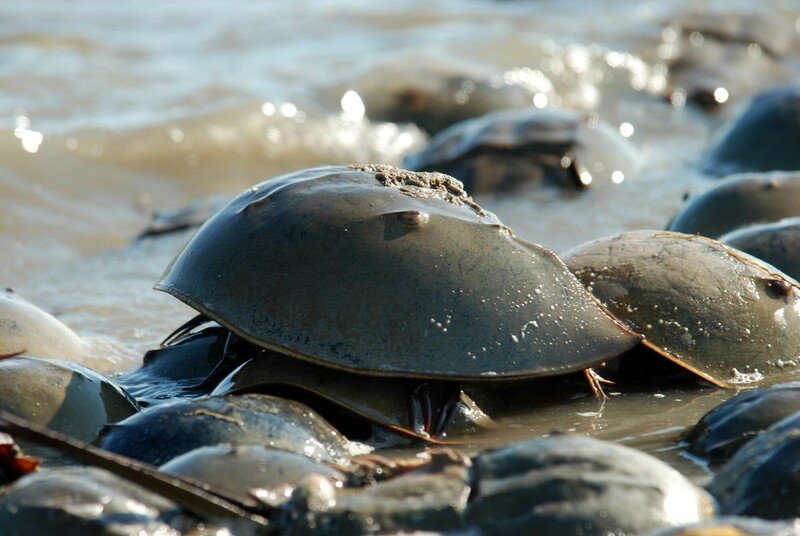
BOSTON— The Center for Biological Diversity and 12 conservation groups today petitioned Massachusetts to investigate whether its horseshoe crab harvests are harming state and federally protected species including red knots and loggerhead sea turtles.
“This is the definition of unsustainable. Massachusetts is allowing so many horseshoe crabs to be killed that even the animals who depend on them are veering toward extinction,” said Danny Waltz, a senior attorney at the Center for Biological Diversity. “The Commonwealth must use every tool it has to save red knots and sea turtles, including ending horseshoe crab harvests. A thorough investigation of this program is the very least state officials could do.”
The Massachusetts Division of Marine Fisheries authorizes the catching and killing of hundreds of thousands of horseshoe crabs, depleting essential food resources for sea turtles and shorebirds protected under both the federal and Massachusetts endangered species acts.
Today’s petition asks the secretary of Massachusetts’ Executive Office of Energy and Environmental Affairs to authorize a review of the program under the state’s endangered species act to determine its potential damage to state-listed species or their habitats. If the secretary initiates a review of the agency’s horseshoe crab harvesting program, state law requires consultation with Massachusetts’ endangered species program to identify steps to avoid damaging state-listed plants and animals, including red knots and loggerhead sea turtles.
“The Division of Marine Fisheries’ data do not demonstrate that horseshoe crab populations have recovered to anything approaching their historical abundance, much less to levels sufficient to fulfill their essential ecological functions,” said Sharl Heller, president of Southeastern Massachusetts Pine Barrens Alliance. “We need management that measures success by the restoration of the horseshoe crabs’ ecological role, not simply by whether enough animals remain to sustain a commercial harvest.”
“Horseshoe crabs are animals who deserve protection in their own right, and they play a vital role in coastal ecosystems,” said Stephanie Harris, senior legislative affairs manager at the Animal Legal Defense Fund. “We look forward to working with Massachusetts to strengthen protections for these remarkable animals and the vulnerable wildlife that depend on them, including red knots and loggerhead sea turtles.”
“The survival of state and federally listed red knots depends on a healthy horseshoe crab population, something made nearly impossible under current Massachusetts law,” said Hardy Kern, director of policy and government affairs at American Bird Conservancy. “Without a meaningful change, the future of these birds is in the balance.”
Horseshoe crab populations have plummeted by more than 70% in recent decades because of overharvesting, especially from biomedical companies. The companies harvest the blood of horseshoe crabs for drug safety testing even though synthetic alternatives are approved, available and used widely in Europe and Asia. Horseshoe crabs are also killed for use as bait by the commercial whelk and eel fisheries.
As horseshoe crabs have declined, so have other species that feed on them, like sea turtles and shorebirds. The red knot, a bird that feeds on horseshoe crab eggs during their 19,000-mile migration from South America to the Arctic and back, was protected as threatened under the federal Endangered Species Act in 2015. That listing decision cited horseshoe crab overharvesting as one of the contributing factors to red knots’ decline. The red knot is also listed as threatened under the Massachusetts Endangered Species Act.
Additional petitioners include the American Bird Conservancy, Animal Legal Defense Fund, Animal Welfare Institute, Conservation Law Foundation, Defenders of Wildlife, the Horseshoe Crab Recovery Coalition cofounders, Humane World for Animals, International Conservation Fund, Massachusetts Society for the Prevention of Cruelty to Animals, Sea Turtle Conservancy, Southeastern Massachusetts Pine Barrens Alliance and New Jersey Audubon.