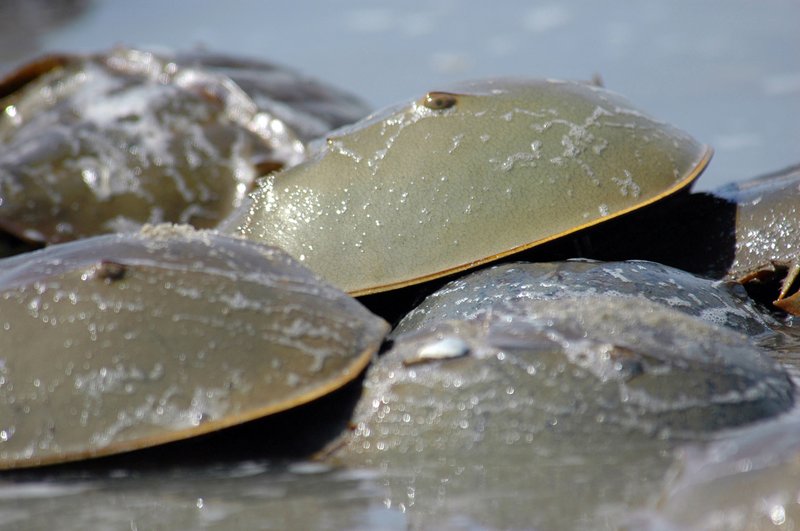
CAPE MAY, N.J.— The Center for Biological Diversity and allies today petitioned a New Jersey agency to issue a declaratory ruling on a biomedical company’s persistent violation of the state’s moratorium on harvesting, killing and injuring horseshoe crabs.
“On paper, New Jersey is one of the best state protectors of horseshoe crabs, but look under the hood and you’ll find it’s actually allowing a company to kill and injure horseshoe crabs in huge numbers,” said Danny Waltz, a senior attorney at the Center for Biological Diversity. “New Jersey must act quickly to fulfill the promise of its own laws and protect these highly imperiled animals and the endangered birds who depend on healthy crab populations.”
Through records requests made to the state, the conservation groups recently uncovered reports showing that Limuli Laboratories, a Cape May County biomedical company, annually injures thousands of horseshoe crabs as part of its collection of crabs to harvest their blood. Hundreds of these horseshoe crabs die. Limuli’s owner also publicly acknowledged that her company picks up horseshoe crabs by their telsons (tails), despite the scientific understanding that lifting crabs by their telsons can cause life-threatening harm.
Today’s petition asks the New Jersey Department of Environmental Protection to review Limuli’s activities under the state’s 2008 statutory moratorium on the harvesting of horseshoe crabs and issue a declaratory ruling as to whether Limuli is violating the law.
The moratorium generally prohibits all collection of horseshoe crabs, with an exception for capturing horseshoe crabs to harvest their blood for biomedical purposes. However, this exception requires the horseshoe crabs to be released “otherwise unharmed to the same waters from which they were collected.” The petition argues that the horseshoe crabs Limuli kills and injures are not released otherwise unharmed.
Horseshoe crab populations have plummeted by more than 70% in recent decades because of overharvesting, especially by biomedical companies. The companies drain the blood of horseshoe crabs for drug safety testing even though synthetic alternatives are approved, available and used widely in Europe and Asia. Biomedical harvests in the United States have doubled in the past several years, with more than 1 million horseshoe crabs harvested in 2024.
Horseshoe crabs are also harvested for use as bait by the commercial whelk (edible carnivorous snails) and eel fisheries.
New Jersey’s legislature enacted the horseshoe crab harvest moratorium to protect the state’s imperiled shorebird populations, including the Endangered Species Act-listed red knot. Red knots are known for making 19,000-mile round-trip migrations. They migrate from as far south as the Tierra del Fuego archipelago at the southern tip of South America all the way to their breeding grounds in the Arctic, stopping in the United States along the way in both directions. The largest northbound stopover is Delaware Bay, where the birds feast on horseshoe crab eggs to fuel the remainder of the migratory journey.
As overharvesting depleted horseshoe crab stocks, the red knot and other shorebird populations steeply declined. Experts have calculated that the red knot has seen a 94% decline in abundance. Responding to this glaring extinction threat, New Jersey’s legislature intervened to protect the shorebirds’ key food source — horseshoe crab eggs. Today’s petition asks New Jersey Department of Environmental Protection to fully adhere to the legislature’s moratorium.
Petitioners include the Center for Biological Diversity, New Jersey Audubon Society, New Jersey Conservation Foundation, Citizens United to Protect the Maurice River and Its Tributaries, League of Women Voters of New Jersey, Save Coastal Wildlife, American Bird Conservancy, Humane World for Animals, National Wildlife Federation, Delaware Riverkeeper Network, NY/NJ Baykeeper, Upstream Alliance, Delaware Audubon Society, Delaware Ornithological Society, Maryland Bird Conservation Partnership, Friends of the Bay, Professor Tim Cernak, Coastal Expeditions and the Coastal Expeditions Foundation, 100 Miles and Maritime Aquarium at Norwalk.