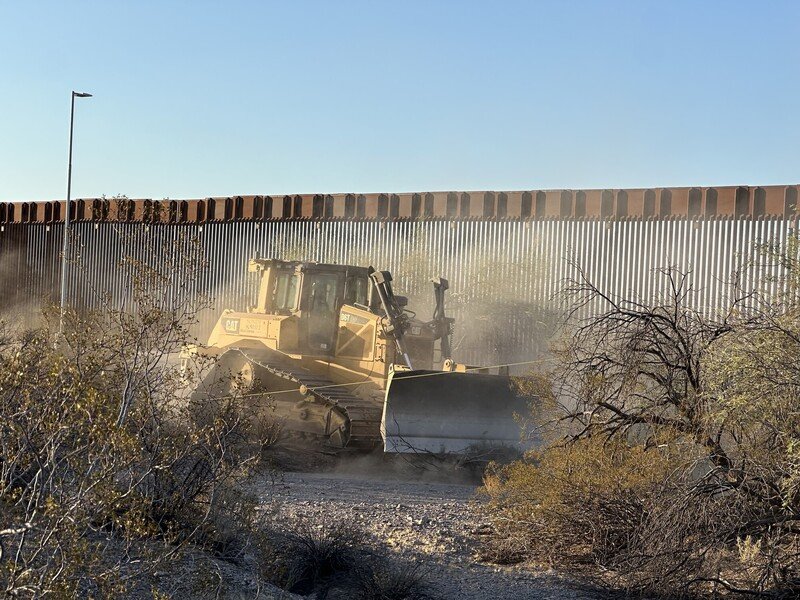
AJO, Ariz.— The Center for Biological Diversity released footage today showing bulldozers plowing a path for a second border wall just 0.7 miles from Quitobaquito Springs on the U.S.-Mexico border in Arizona’s Organ Pipe Cactus National Monument.
The second wall is being built around 100 feet north of the existing wall inside the protected national monument, with construction rapidly approaching the ecologically and culturally invaluable desert spring.
“I’ve been watching federal contractors butcher Organ Pipe for months and it’s horrifying to see bulldozers now plowing toward Quitobaquito,” said Russ McSpadden, a Southwest conservation advocate at the Center. “Instead of protecting one of North America’s most extraordinary desert springs, the Trump administration is about to destroy it. This would obliterate its rich cultural heritage and condemn the rare animals that depend on the spring to extinction.”
Quitobaquito Springs and the surrounding desert are a sacred area for the Hia-Ced O’odham and Tohono O’odham people.
Bulldozing and groundwater pumping for construction could permanently damage the spring’s fragile hydrology.
The spring is home to the endangered Quitobaquito pupfish, the endangered Sonoyta mud turtle and the Quitobaquito tryonia, a tiny springsnail. The tryonia and pupfish are found nowhere else on Earth. One other population of mud turtles is thought to live in Mexico’s Rio Sonoyta.
The Center successfully advocated for Endangered Species Act protection and critical habitat for the Sonoyta mud turtle and has repeatedly challenged threats to the pupfish and Quitobaquito Springs.
In May, the Center sued the Trump administration for failing to finalize Endangered Species Act protections for the Quitobaquito tryonia after the U.S. Fish and Wildlife Service determined in 2023 that it should be listed as endangered.
According to recent reporting, wildlife agencies, zoo officials and species recovery experts have been rushing to implement emergency salvage plans for all three species as border wall construction could destroy the pond or the springs that feed it.
“The administration needs to halt construction immediately and work with Tribes and conservation experts to avoid irreversible harm to this teeming desert oasis,” said McSpadden. “If Trump doesn’t act, our state leaders and representatives in Congress have to stop the destruction. Americans overwhelmingly want these and other public lands protected for future generations.”
Background
Organ Pipe Cactus National Monument contains many archaeological and cultural sites associated with thousands of years of human use of the Sonoran Desert.
Quitobaquito Springs has been occupied by people for thousands of years and is part of the historic homeland of the Hia C-ed O’odham and Tohono O’odham. The area contains archaeological artifacts and remains culturally significant to O’odham people.
In April border wall contractors working in the nearby Cabeza Prieta National Wildlife Refuge destroyed part of the Las Playas Intaglio, an approximately 1,000-year-old fish-shaped geoglyph. Contractors scraped a roughly 50-foot-wide construction corridor through the 272-foot-long cultural site while working on border wall construction.
The new clearing inside Organ Pipe Cactus National Monument comes as the Tohono O’odham Nation has been fighting the Trump administration’s plans to build two border walls across reservation lands.
The Nation filed a lawsuit in June challenging the planned construction, saying the federal government and its contractors would be trespassing on Tribal lands and that construction would damage sacred sites and threaten important ceremonies and religious practices.
In August the Nation posted no-trespassing signs in response to concerns about federal contractors entering tribal lands for border wall work. Federal police have since provided contractors access over the Tribe’s opposition.
Photos and videos are available for media use.