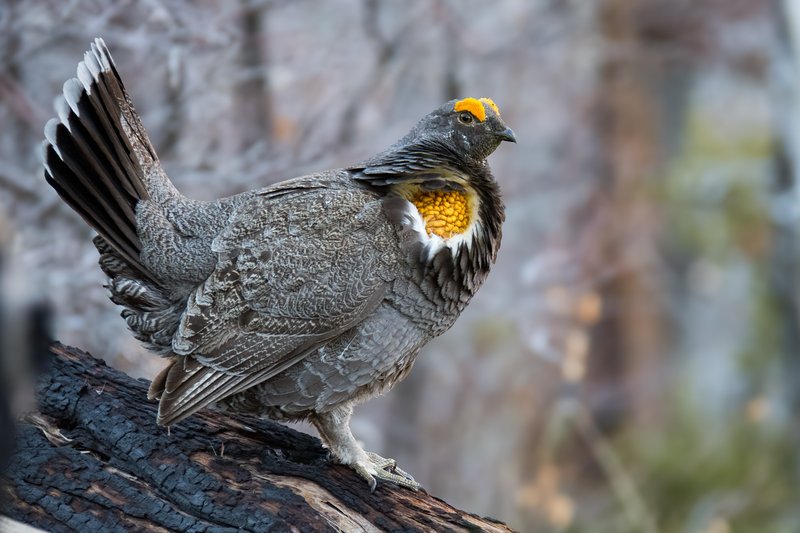
SACRAMENTO, Calif.— The California Fish and Game Commission voted today to designate the Mount Pinos sooty grouse as a candidate for protection under the California Endangered Species Act. The vote came in response to a March 2026 petition by the Center for Biological Diversity and Los Padres ForestWatch.
This high-elevation grouse subspecies, which is known for hooting from treetops, has been lost from the mountains of the northern Transverse Ranges and may only persist in a dwindling portion of the southern Sierra Nevada.
“Sooty grouse have already been driven out of their namesake Mount Pinos and the rest of Southern California’s Transverse Ranges, so protection is absolutely crucial for surviving populations in the Sierra Nevada,” said Jeff Miller, a senior conservation advocate at the Center. “These fascinating birds desperately need the intact old-growth conifer forests and high-elevation meadows that are so at risk from logging and cattle grazing.”
“The disappearance of Mount Pinos sooty grouse has left an ecological void in the unique sky-island forests of Los Padres National Forest,” said Jeff Kuyper, executive director of Los Padres ForestWatch. “Today’s decisive action by the commission will help ensure that other populations don’t suffer a similar fate and opens the door to a future conversation about restoring Mount Pinos sooty grouse to its historic habitat.”
Logging, livestock grazing, rural development, and fire suppression appear to have eliminated sooty grouse by the 1980s from their historic “sky island” mountains in Southern California, including from the Tehachapi Mountains and Mount Pinos region of Ventura County. Sooty grouse that may belong to the Mount Pinos subspecies survive in high-elevation forests and meadows in the southern Sierra Nevada south of Kings Canyon within Fresno, Tulare, Inyo and northern Kern counties.
Sooty grouse in the southern Sierra Nevada are also declining because of logging, livestock grazing within meadows they need for brooding and raising their young, fire suppression resulting in elevated fire risk, and loss of high-elevation forest and meadow habitat because of climate change. Continued hunting of grouse within their remaining southern Sierra Nevada range poses an additional threat.
Unlike sage grouse and other related North American species that participate in communal courtship displays, male sooty grouse are strongly territorial. During spring breeding season, individual male birds hoot from the tops of tall trees to attract females. Hooting sites are typically located in massive fir or pine trees and are returned to for generations.
Although sooty grouse populations are shielded from habitat destruction and hunting within Sequoia and Kings Canyon national parks, grouse habitat within the Sequoia and Inyo national forests remains open to logging, grazing and hunting. The species has already been eliminated from Los Padres National Forest.
The Mount Pinos sooty grouse is now designated as a candidate species while the California Department of Fish and Wildlife conducts a status review. Candidate species receive the safeguards of a state threatened species, including a prohibition against unauthorized killing or take. A genetic study is needed to resolve taxonomic uncertainty for sooty grouse in the southern Sierra Nevada south of Kings Canyon to determine whether they belong to the Mount Pinos or Sierra subspecies.
The Center also petitioned the U.S. Fish and Wildlife Service in 2024 for federal Endangered Species Act protection for Mount Pinos sooty grouse.