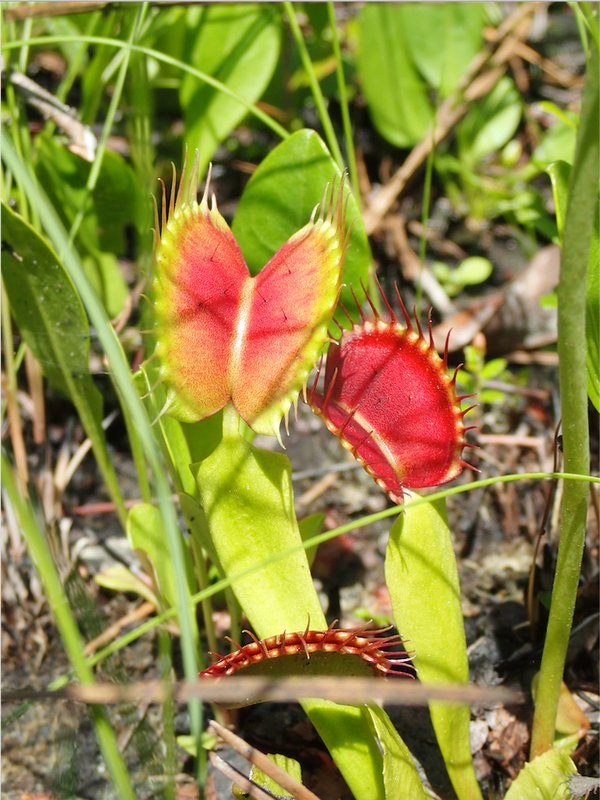
WILMINGTON, N.C.— The Center for Biological Diversity notified the U.S Fish and Wildlife Service today of its intent to sue the agency for denying Endangered Species Act protections to the imperiled Venus flytrap. These iconic plants live in the wild only along the coastal plain of North and South Carolina and nowhere else in the world.
“These charismatic carnivorous plants need Endangered Species Act protections because they’ve nearly disappeared from the wild, and development is devouring what’s left of their habitat,” says Will Harlan, a senior scientist at the Center. “The Fish and Wildlife Service must act quickly to snatch these snapping plants from the jaws of extinction.”
Called one of “the most wonderful plants in the world” by Charles Darwin, these widely recognized plants have two jaw-like leaves that snap shut around their prey in a fraction of a second. Venus flytraps have declined by 98% in the wild, primarily because of habitat destruction, poaching, lack of wildfire and climate change. Wild populations are limited to a small area near Wilmington, North Carolina, which is one of the most rapidly developing regions in the country.
“This feisty little plant was once far more abundant and widespread. Development, climate change and poor management have reduced it to just a handful of isolated populations,” said Don Waller, retired professor of botany at the University of Wisconsin and lead author of the Venus flytrap listing petition. “Given its tiny range and these threats, the Venus flytrap amply deserves protection as an endangered species.”
Venus flytraps live in wet, open longleaf pine savannas and need frequent fires to prevent their habitat from being overgrown. Development in their remaining range has destroyed much of their remaining habitat and severely limited prescribed burns.
Most remaining Venus flytraps are found in just three areas in the Carolina coastal plain that are vulnerable to sea level rise and extreme weather. Venus flytrap populations on federal and state lands currently do not receive any specific legal safeguards, and smaller populations on private lands are completely unprotected.
In 2016 the world’s leading plant scientists petitioned to list the Venus flytrap under the Endangered Species Act. After making an initial finding that the species may warrant protections, the Service delayed making its required listing decision until forced to act by a Center lawsuit. In 2023 the Service denied Endangered Species Act protections.
The Service’s decision improperly assumed that all remaining large flytrap populations will continue be actively managed by prescribed fire, failed to acknowledge the risk of sea-level rise and unlawfully concluded that the loss of all remaining flytrap populations in the Sandhills and Inner Coastal Plain region was not significant.
Unlike their portrayal in popular culture, Venus flytraps grow only 5 inches tall. Their burgundy and lime-green toothed leaves contain sensitive hairs that trigger the snap trap. Plants take up to 10 days to digest captured prey, which can include ants, spiders, flies and even small frogs.