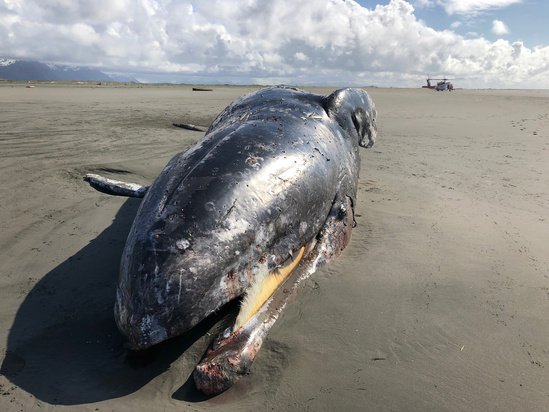
OAKLAND, Calif.— Three conservation groups filed a lawsuit today against the U.S. National Marine Fisheries Service for failing to issue a decision on Endangered Species Act protections for the Eastern North Pacific gray whale.
“Science is clear that gray whales are endangered and federal law is equally clear that the government must list them and protect them as such, irrespective of the current administration’s political ideology,” said Professor Rick Steiner, founder of Oasis Earth in Anchorage. “As this administration has again failed to follow the law, we must again rely on the courts to force the government to do its job.”
In response to a 2025 petition to protect the whales, the Fisheries Service was supposed to issue an initial finding on the petition by Nov. 22, 2025, but failed to do so.
There has been a catastrophic die-off of gray whales along the West Coast this year. But the Trump administration has taken no action to protect the whales.
The Eastern North Pacific gray whale population has declined by as much as 50% in the past decade. This population of gray whales was protected under the Endangered Species Act until it was declared recovered and delisted in 1994. Unfortunately, the gray whale recovery was short-lived.
“The number of gray whales dying in the Pacific is staggering. The Trump administration is required to act, and we won’t stand by and watch them do nothing to help these beloved whales,” said Miyoko Sakashita, oceans director at the Center for Biological Diversity. “It’s really concerning that so many gray whales aren’t making it back to Alaska on their long migration. This population has recovered from a low point before and can do it again but the whales need the help of U.S. protections.”
At least 192 gray whales have stranded and died along the West Coast so far in 2026, according to NMFS, and hundreds more have died in recent years. Many whales die because they are hit by ships and entangled in fishing gear. Scientists regard documented cases as an undercount, because most dead whales sink to the bottom of the ocean and their deaths are never recorded.
“The gray whales, who have shown resilience recovering from 19th and 20th century whaling, are now on the decline,” said Mark J. Palmer, associate director of International Marine Mammal Project of Earth Island Institute. “This catastrophic decline may result in the loss of the entire population in as soon as 10 years, if current conditions continue. In 2025 only 85 calves were counted during the migration, the lowest number in 30 years. The government must act now to protect these whales.”
Most of the recent dead gray whales were emaciated, likely because Arctic warming has limited their prey. The whales normally eat small animals such as amphipods, little shrimp-like crustaceans that live on the seafloor.
The amphipods depend on a food chain that begins with sea ice. When sea ice melts earlier and forms later, less of the algae and zooplankton that amphipods eat reaches the seafloor. That means there are fewer amphipods and small animals for gray whales to eat before migration.
Today’s lawsuit was filed in U.S. District Court in the Northern District of California. The lawsuit says the Service failed to respond to the group’s Aug. 25 notice of intent to sue within 60 days as required by federal law.