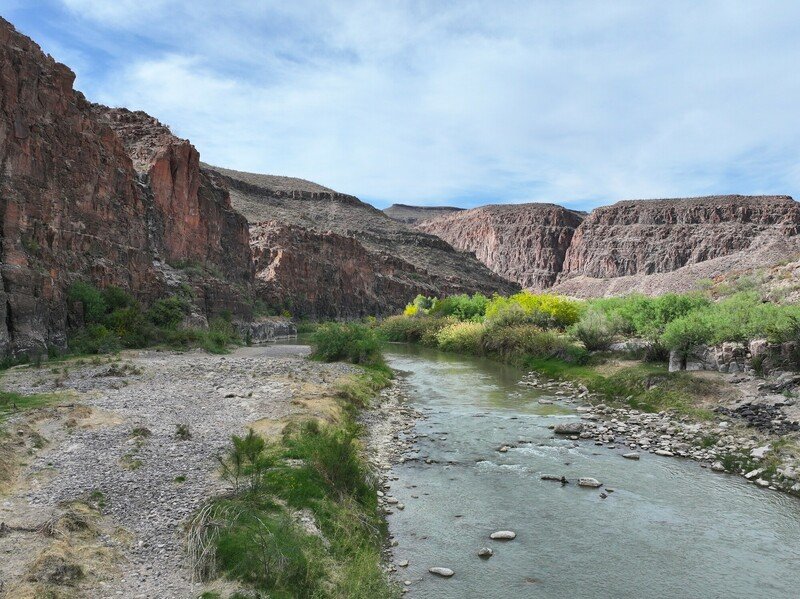
TERLINGUA, Texas— The Center for Biological Diversity, Friends of the Ruidosa Church, and a Big Bend-area river guide and landowner sued the Department of Homeland Security today for unconstitutionally waiving dozens of laws to fast-track border wall construction through the Big Bend region of Texas. The lawsuit argues the department is exercising powers Congress never authorized.
“The Department of Homeland Security has unconstitutionally gutted our nation’s bedrock environmental laws to build a wildlife-killing wall that would permanently lock away the Rio Grande,” said Laiken Jordahl, national public lands advocate at the Center for Biological Diversity. “This is straight out of the playbook they used in Arizona, where federal contractors blew up sacred Indigenous sites, bulldozed canyon walls and drained precious aquifers to build border walls. They’re trying to slam an iron curtain through the Big Bend region, gouging a wound that will never heal into one of America’s most beautiful wild places.”
A border wall would sever public access to the Rio Grande, devastating the region’s river outfitters, its recreation economy, dark skies, and natural and cultural heritage. It would also split wildlife populations, including black bears and Carmen Mountains white-tailed deer, leaving populations isolated and vulnerable to decline.
“This place isn’t just where I work, it’s where I’ve built my life and raised my kid. We call the Rio Grande our cathedral,” said Billy Miller, a professional river guide and landowner in Redford, Texas. “I’ve spent more than two decades guiding on the river, and if a border wall cuts off access, that’s the end of my career. No one comes to Big Bend to see steel walls and razor wire. If they build this, they’re not just destroying a landscape, they’re wiping out our way of life.”
Today’s lawsuit, filed in U.S. District Court in the Western District of Texas, argues the federal government violated several constitutional provisions, including the major questions doctrine, which requires clear congressional approval for actions with vast economic and political consequences.
The Department of Homeland Security waived dozens of laws that protect clean air and water, public lands, wildlife, and historic resources to build a cross-continental wall along the entire southern border. Because the Big Bend waiver advances that broader, highly consequential project without explicit approval from Congress, the lawsuit argues it is unconstitutional.
“The federal government is operating with zero regard for the damage a new border wall would bring to Big Bend,” said Rochelle M. Garza, president of the Texas Civil Rights Project. “If the moves DHS has publicly made can be deemed unconstitutional, that inspires little confidence in the ethics of decisions being made behind closed doors. On behalf of all who enjoy its grandeur, Big Bend locals and advocates are demanding clarity and fighting to protect the lands they know best.”
Last week the Center and Texas Civil Rights Project filed a separate lawsuit over the government’s refusal to release basic records on border wall plans in the region.
“Ruidosa Church has stood for generations, but it was never built to withstand the industrial shockwaves border wall construction would bring,” said Jordan Martinelli with Friends of the Ruidosa Church. “Wall construction would industrialize this remote stretch of the Rio Grande and place one of the region’s most beloved historic structures in harm’s way. It’s being fast-tracked by waiving laws like the National Historic Preservation Act, stripping this church of the legal protections every other historic site in the country is guaranteed.”
In October 2025 the department waived federal procurement laws for border construction across the entire U.S.-Mexico border, including Big Bend Ranch State Park and Big Bend National Park. In February 2026 the agency issued a separate waiver of environmental, cultural resource and other laws to fast-track wall construction in the Big Bend region.
The federal government has since awarded construction contracts, including a $1.2 billion contract to North Dakota-based Fisher Sand and Gravel. The company has paid millions of dollars in penalties for numerous environmental violations.
Local media have reported that contractors surveyed land inside Big Bend National Park and Big Bend Ranch State Park, and residents have documented crews installing survey stakes for wall construction in the state park and nearby areas. Customs and Border Protection has repeatedly revised its online maps and issued conflicting statements about whether walls would be built in the parks.
In late February the agency released planning maps showing border walls along every accessible stretch of the Rio Grande in both parks. After bipartisan outcry from local sheriffs, residents, elected officials and business leaders, Customs and Border Protection revised those maps. Updated versions removed physical wall segments from the parks and replaced them with “detection technology,” an undefined term, while still targeting hundreds of miles of border for walls upriver from the parks. The agency has said barriers in the parks are “still in the planning stages,” signaling it could move ahead without public notice, input or congressional approval.
Today’s lawsuit also challenges Homeland Security’s claim that the Big Bend Sector is an “area of high illegal entry,” noting that it has the lowest number of crossings along the southern border and historically low apprehensions. The sector covers roughly a quarter of the border but accounts for just 1.3% of all Southwest border apprehensions.
In March more than 130 organizations, outfitters and rural Texas businesses urged Congress to block federal funding for border wall construction in the Big Bend region.
The plaintiffs are represented by attorneys at the Center for Biological Diversity and Texas Civil Rights Project.