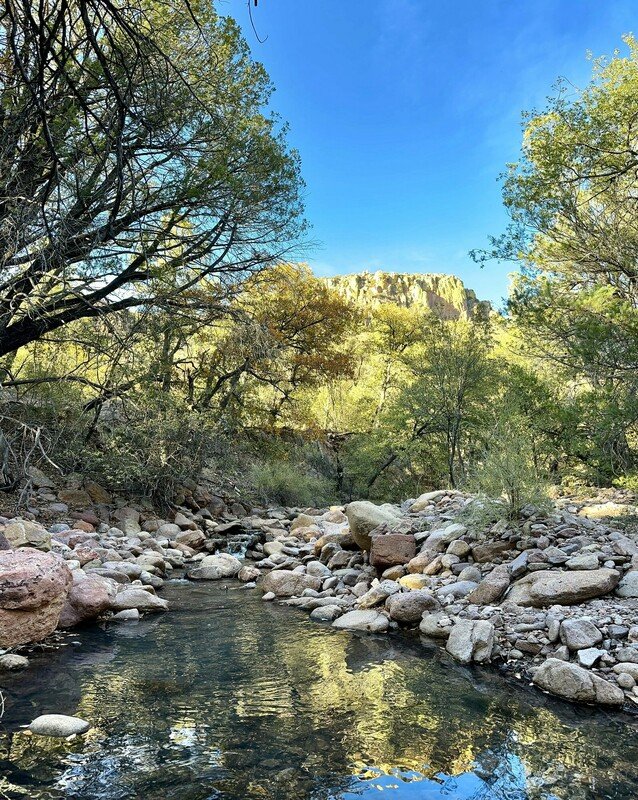
TUCSON, Ariz.— In response to a lawsuit by environmental groups, a federal court has overturned a U.S. Forest Service plan to build new roads and allow increased motorized access through three sensitive canyons in southeastern Arizona’s Chiricahua Mountains.
The remote canyons, located in the Coronado National Forest, are known to be used by federally protected jaguars. New roads could put endangered wildlife at risk from noise and other disturbances, increase the threat of wildfires and pollute clean water.
“This ruling is a well-deserved victory for the jaguars that roam southern Arizona and for the species’ recovery,” said Taylor McKinnon, Southwest director at the Center for Biological Diversity. “Jaguar recovery requires protecting the places they live, and this plan would have brought new roads and motorized use in the heart of those remote canyons. With jaguars making headlines week after week, Arizonans are rooting for jaguars to recover but the Forest Service is standing in their way. It’s time for the agency to get with the program and ditch this illegal plan for good.”
In a decision issued late Wednesday, the court ruled that the biological opinion for the Chiricahua Access Project violated the Endangered Species Act’s “best available science” standard by failing to consider research cited in the Jaguar Recovery Plan on the effects of roads on the cats. The court also found the opinion failed to include required measures to minimize harm or sufficient triggers for additional analysis.
The court further ruled that the project violated the National Forest Management Act by failing to account for northern goshawk habitat requirements in the Coronado National Forest’s management plan.
For many years the Chiricahuas has been used by Sombra, a male jaguar whose name means “shadow” in Spanish. Students at the Paulo Freire Freedom School in Tucson gave him the name.
New roads through the Chiricahua Mountains’ remote canyons would make it easier for hunters — including hound hunters — to reach these areas, while also increasing access for destructive off-road vehicles, woodcutting and other noisy activities that could drive jaguars away.
“We commend the court for supporting the protection of jaguar habitat in the Chiricahuas,” said Dirk Sigler of the Chiricahua Regional Council. “Allowing the construction of roads for motorized travel within these uniquely sensitive wild areas is not only unnecessary but irreversibly destructive. The Chiricahua Regional Council celebrates this decision.”
The New York Times recently reported detections of one, or possibly two, female jaguars in Cuenca los Ojos, a Mexican preserve on the U.S.-Mexico border, about 35 miles south of the Chiricahua Mountains. Those detections, now a few years old, raise the possibility that jaguars are breeding in the preserve and that a female could roam into the U.S. in search of a mate. Jaguars once bred in the U.S., with their historic range extending as far north as the Grand Canyon.
In June 2024 the Center for Biological Diversity, Sky Island Alliance and the Chiricahua Regional Council petitioned the Forest Service to designate 5,500 acres in one of these canyons as the Izęę’ Bich’ilwozh (Medicine Canyon) Zoological-Botanical Area. The White Mountain Apache Tribe’s cultural preservation office also urged the Forest Service to protect the proposed zoological-botanical area and to avoid building roads that would increase motorized traffic.
“The legacy of these precious canyons, evolving from an ancestral homeland into a revered icon of conservation and natural wonder, is finally, for now, secure,” said Dr. Aletris Neils, executive director of Conservation CATalyst.
“This was a bad idea from the start — a road project packaged as public access that really serves only the forest users who already have the most access, advanced over the objections of the public, and built on an analysis the Forest Service never actually did,” said David Hodges with Natural Allies. “We're thrilled the courts saw it for what it was and acted to protect rare and imperiled wildlife.”
The area’s exceptional biodiversity includes bears, coatimundis, bobcats, Mexican spotted owls, golden eagles, jaguars and elegant trogons. This part of the Chiricahuas supports more than 100 species identified as species of concern by the Arizona Game and Fish Department, as well as numerous rare and culturally significant plant species.
The Center for Biological Diversity, Conservation CATalyst, Natural Allies and Wild Arizona were represented in the litigation by Lisa Belenky and Tala DiBenedetto of the Center for Biological Diversity, and Adriane Hofmeyr of Hofmeyr Wang.